想象一个武装团体袭击一个拥有中东地区最先进的军队和防空系统之一的国家。胡塞武装正是如此行动的——他们控制也门部分地区,并发动了这次袭击。沙特阿拉伯购买了美国出售的两种最强大的防空系统——爱国者(Patriot)和萨德(THAAD)。尽管如此,胡塞武装仍然突破防线,击中了利雅得市中心的国际机场。即使是吉达——沙特阿拉伯首次部署THAAD系统的地方——也被拉响了导弹警报。
Imagine an armed group attacking a country that has one of the most advanced militaries and air defences in the Middle East. That’s exactly what the Houthis, who control parts of Yemen, have done. Saudi Arabia bought two of the most powerful air defence systems America sells, Patriot and THAAD. Still, the Houthis broke through and hit an international airport in the heart of Riyadh. Even Jeddah, where Saudi Arabia launched its very first THAAD unit, was put on missile alert.
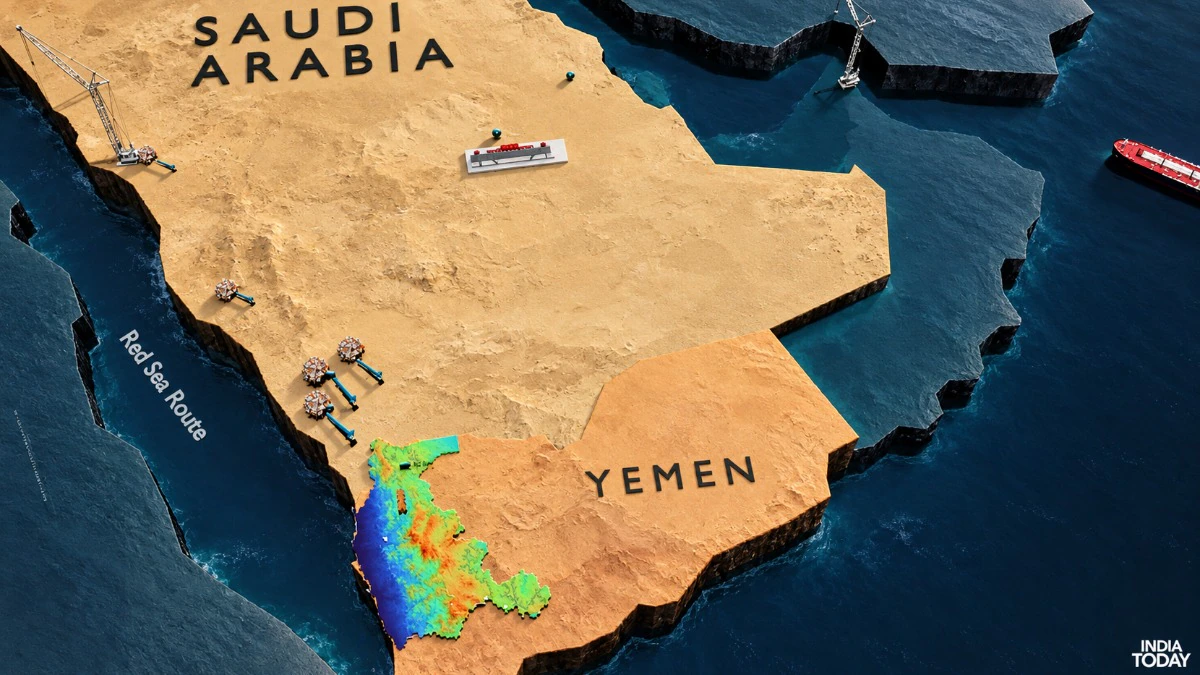
也门的高耸高地可能为胡塞武装的无人机和导弹提供潜在的高度优势,而山谷和地形掩蔽则可能使探测变得复杂。对沙特阿拉伯的防空系统而言,挑战不仅在于武器能飞多远,而在于防御方可能只有极短的预警时间来做出反应。利雅得距胡塞武装据点萨达约910公里,吉达距萨达约715公里。因此,这已不再是边境冲突,而是深入王国腹地的战争。
Yemen’s towering highlands may give Houthi drones and missiles a potential altitude advantage, while valleys and terrain masking can complicate detection. For Saudi Arabia’s air defences, the challenge is not just how far a weapon travels, but how little warning time defenders may have to reactRiyadh is about 910 km from Saada, the Houthi stronghold. Jeddah is about 715 km. And hence, this is not a border skirmish anymore but a war deep inside the kingdom.
至少有18人死亡,超过300人受伤,机场一直关闭至10月17日。那么,这一切是如何发生的?印度今日的公开源情报团队(OSINT)着手调查此事。他们绘制了王国境内报告的袭击事件,并确定了袭击目标。随后,他们循线追溯至伊朗,追踪胡塞武装武器库的来源。胡塞武装拥有能够深入沙特阿拉伯腹地打击目标的导弹和无人机混合 arsenals,尽管在此次利雅得机场袭击中所使用的具体武器仍未被确认。
At least 18 people died, more than 300 were injured, and the airport stays closed till October 17. So how did it happen? India Today’s open-source intelligence team (OSINT) set out to answer that. We mapped reported attacks across the kingdom and pinned down what was targeted. It then followed the trail back to Iran, tracing the origins of the Houthis’ arsenal. The Houthis possess a mix of missiles and drones capable of striking targets deep inside Saudi Arabia, though the weapons used in the Riyadh airport attack remain unknownSaudi Arabia has some of the best missile defence in the world.
沙特阿拉伯拥有世界上一些最好的导弹防御系统。它使用两种美国系统——爱国者(Patriot)和萨德(THAAD)——来在空中拦截导弹。但胡塞武装(也称为安萨尔·拉赫,一个得到伊朗支持的组织)仍然能够突破防线。他们多次袭击利雅得机场。10月10日的袭击是沙特阿拉伯十年来遭遇的最严重一次。此前,这场冲突主要发生在边境附近。
It uses two American systems, Patriot and THAAD, which shoot down missiles in the air. But the Houthis, also called Ansar Allah, a group backed by Iran, are still getting through. They have hit the airport in Riyadh again and again. The attack on October 10 was the worst Saudi Arabia has seen in over ten years. This fight used to be far away near the border.
现在它已经抵达首都。尽管在美制爱国者和萨德系统上花费了数十亿美元,沙特阿拉伯的防空系统仍然容易受到胡塞武装袭击。地理因素塑造了南部的威胁。胡塞武装的袭击威胁着沙特阿拉伯的关键航空基础设施,暴露了其防空系统的局限性。这张地图绘制了王国范围内的报告袭击,突显了南部地区袭击的集中以及威胁已延伸至主要城市中心。
Now it has reached the capital. Despite billions spent on US-made Patriot and THAAD systems, Saudi Arabia’s air defences remain vulnerable to Houthi strikesGeography shapes the threat in the southHouthi attacks have threatened Saudi Arabia’s critical aviation infrastructure, exposing the limits of its air defences. This map plots reported strikes across the kingdom, highlighting the concentration of attacks in the south and threats reaching major urban centresFrom Jizan, near the Yemeni border, to Riyadh deep inside the kingdom, the geography of Houthi attacks reveals a widening threat.
从靠近也门边境的吉赞,到王国深处的利雅得,胡塞武装袭击的地理分布揭示了威胁的扩大。沙特阿拉伯外交部表示,胡塞武装的袭击针对阿卜哈、哈米斯穆舍特、吉赞和纳杰兰的平民和经济目标。华盛顿的外交政策和国家安全智库——战略与国际研究中心(CSIS)的一项早期研究分析了4103次胡塞武装袭击。研究发现,阿西尔、吉赞和纳杰兰地区占沙特阿拉伯境内袭击的80%以上。
Saudi Arabia’s Foreign Ministry said Houthi attacks targeted civilian and economic sites in Abha, Khamis Mushait, Jazan and Najran. An earlier study by the Center for Strategic and International Studies (CSIS), a Washington-based foreign policy and national security think tank, analysed 4,103 Houthi attacks. It found that Asir, Jazan and Najran accounted for more than 80% of attacks inside Saudi Arabia.
研究指出,这些地区靠近也门,“限制了沙特防空系统的反应时间”。尽管该研究基于2016年1月至2021年10月的数据,早于最新的升级,但它指出了沙特阿拉伯南部边境长期存在的脆弱性。然而,威胁远远超出了南部边界。9月24日,沙特领导的联盟表示,已拦截六枚瞄准泰夫和亚努卜的弹道导弹,亚努卜是红海关键的石油出口枢纽。到10月11日,沙特当局还报告称,东部达曼的法赫德国际机场也遭到袭击。
Their proximity to Yemen, the study noted, “limits the reaction time of Saudi air defense systems.”Although the study is based on data from January 2016 to October 2021, predating the latest escalation, it identifies a longstanding vulnerability along Saudi Arabia’s southern border. However, the threat extends far beyond the southern border. On September 24, the Saudi-led coalition said it had intercepted six ballistic missiles aimed at Taif and Yanbu, a key Red Sea oil export hub. By October 11, Saudi authorities had also reported an attack targeting King Fahd International Airport in Dammam, in the kingdom’s east.
利雅得、泰夫、亚努卜和达曼说明了报告威胁的地理分布。武器库加剧了挑战。从伊朗制造的弹道导弹和反舰武器到本地生产的攻击无人机,胡塞武装的武器库反映了外部支持、技术转让和国内适应的混合。Zulfiqar弹道导弹、Asef(Khalij-e Fars)和Faleq反舰弹道导弹、Al-Mandab-2巡航导弹以及Samad-3和Shihab无人机展示了胡塞武装更广泛武器库的一瞥,该武器库涵盖多种导弹和无人机类别。
Riyadh, Taif, Yanbu and Dammam illustrate the geographical spread of reported threats. The arsenal compounds the challengeFrom Iranian - origin ballistic missiles and anti-ship weapons to locally produced attack drones, the Houthis’ arsenal reflects a mix of external support, technology transfer, and domestic adaptationZulfiqar ballistic missile, Asef (Khalij-e Fars) and Faleq anti-ship ballistic missiles, Al-Mandab-2 cruise missile, and Samad-3 and Shihab drones offer a glimpse of the Houthis’ wider arsenal, which spans multiple missile and drone classes.
据CSIS称,“伊朗为胡塞武装的武器能力提供了支持”,尽管利雅得机场袭击中使用的武器仍未被确认。伊朗支持的安萨尔拉组织的导弹和无人机库存正在扩大,这既增加了其打击的范围,也提高了打击强度。危险在于结合具有不同飞行轨迹的系统。IISS警告称,“弹道导弹和巡航导弹以及其他空气呼吸弹药的联合使用”甚至可能挑战分层防空系统。
“Iran has provided support for Houthi weapons capabilities,” according to CSIS, though the weapon used in the Riyadh airport attack remains unidentified. Iran-backed Ansar Allah’s expanding arsenal of missiles and drones has increased both the reach and intensity of its strikesThe danger lies in combining systems with different flight profiles. The IISS warns that “the combined use of ballistic and cruise missiles and other air-breathing munitions” can challenge even layered air defences.
低空飞行的无人机和巡航导弹也可能使防御者留下更少的反应时间。成本失衡加剧了挑战。CSIS援引的历史估计显示,爱国者拦截弹的成本超过100万美元,而一些胡塞武装无人机的成本仅为几百美元。沙特阿拉伯可能拦截大多数来袭威胁,但一旦有一件武器到达机场或油气设施,仍可能造成人员伤亡和干扰。问题在于昂贵的防御面对更便宜、持续的威胁。
Low-flying drones and cruise missiles can also leave defenders less time to respond. The cost imbalance compounds the challenge. CSIS has cited historical estimates of more than $1 million for a Patriot interceptor, compared with a few hundred dollars for some Houthi drones. Saudi Arabia may intercept most incoming threats, but one weapon reaching an airport or oil facility can still cause casualties and disruption. The problem is an expensive defence facing a cheaper, persistent threat.
设计用于摧毁来袭导弹的拦截器可能花费数百万美元,而一些攻击无人机的成本仅为其几分之一。沙特阿拉伯可能一波又一波地拦截威胁,但只需有一件武器突防,就可能导致平民死亡、航班中断或威胁关键基础设施。这就是胡塞武装行动核心的不对称性:防御者必须几乎拦截一切;攻击者只需让一件武器突防即可。- 结束
Interceptors designed to destroy incoming missiles can cost millions of dollars, while some attack drones cost a fraction of that. Saudi Arabia may stop wave after wave, but it takes only one weapon getting through to kill civilians, disrupt flights or threaten critical infrastructure. That is the asymmetry at the heart of the Houthi campaign: the defenders must stop almost everything; the attackers need only one to get through.- Ends