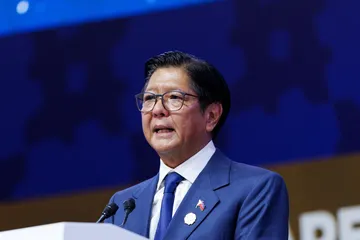
菲律宾总统小费迪南德·马科斯可能召见中国大使,后者似乎暗示如果北京动用武力,可以轻易在与菲律宾的冲突中获胜。
President Ferdinand Marcos Jr. may summon China’s ambassador, who appeared to suggest Beijing could easily win a conflict with the Philippines if it used force.
“在我看来,这听起来很像是一种威胁,而且这不是一种很外交的表述,”马科斯周五对记者说。“我们或许想弄清楚他到底是什么意思。”当被问及是否会召见这位大使时,马科斯说:“我认为这值得我和大使之间讨论一下。”
“It sounds very much to me like a threat and it’s not a very diplomatic statement to be made,” Marcos told reporters Friday. “We perhaps would like to understand what exactly it is that he means.”Asked whether he would call in the envoy, “I think that deserves a discussion between the ambassador and myself,” Marcos said.
中国大使井泉周四在奎松市发表演讲后表示,如果他的国家想动用武力,“我们可以轻易获胜”。他还在对记者的评论中补充说:“但不会的,我们不会使用武力。我们热爱和平。”中国和菲律宾因南中国海争端关系急剧恶化,这一争端在全球贸易关键水道引发了反复对峙。据军事研究机构斯德哥尔摩国际和平研究所的数据,拥有核武器的中国拥有世界上规模最大的军队之一,其国防开支是菲律宾的50多倍。
Chinese Ambassador Jing Quan said after a speech in Quezon City on Thursday that if his country wanted to use force, “we may easily win.”He added in comments to reporters: “But no, we will not use force. We love peace.”China and the Philippines have seen ties deteriorate sharply amid their South China Sea dispute, which has fueled repeated confrontations in a waterway vital to global trade. Nuclear-armed China has one of the world’s largest armed forces, with defense spending more than 50 times that of the Philippines, according to data from the military research institute known as SIPRI.
菲律宾外交部谴责井泉,在一份声明中称其言论“令人遗憾”。声明还称,这位大使“用词不当,似乎传达了几乎不加掩饰的武力威胁,这在菲律宾与中国复杂的双边关系背景下毫无助益。”
The Philippines’ Department of Foreign Affairs rebuked Jing, saying in a statement that his comments were “regrettable.”It added that the envoy “had a poor choice of words that would seem to convey a thinly veiled threat of the use of force, which is hardly helpful in the context of the complicated bilateral ties between the Philippines and China.”
中国驻马尼拉大使馆周五在社交媒体发帖,批评菲律宾外交部“断章取义和过度解读”。
In a social media post on Friday, China’s embassy in Manila criticized the department for its “selective quotation and overinterpretation.”
使馆声明称,双边关系“目前正处于极其敏感的时期”。“我们敦促菲律宾外交部发挥更负责任的作用,防止此类行为,从而确保中菲关系不被推向危险和不确定的境地。”
Bilateral relations “are currently at an extremely sensitive stage,” the embassy’s statement said. “We urge the DFA to play a more responsible role in preventing such actions, thereby ensuring that China-Philippines relations are not pushed into a dangerous and uncertain situation.”