
当前席卷土耳其投资行业的危机可能正蔓延至增长迅速的企业债券市场,进而影响小型企业获取融资的能力。
The crisis roiling Turkey’s investment industry may be spilling into its fast-growing corporate bond market, potentially crimping smaller companies’ access to financing. The turmoil triggered by Tera Portfoy Yonetimi AS and Pusula Portfoy Yonetimi AS last month, after they defaulted on redemptions has sparked steep outflows across the fund industry, slashing total portfolio value by 1.5 trillion liras ($30.3 billion), official data show.
官方数据显示,上个月Tera Portfoy Yonetimi AS与Pusula Portfoy Yonetimi AS未能履行债券赎回义务,由此引发的行业动荡导致大量资金从各类基金中流出,基金总资产价值缩水达1.5万亿里拉(约合303亿美元)。投资者指出,这种情况削弱了基金承担更高风险的能力;尤其是部分资产管理公司本身也持有处于危机核心企业的债券。
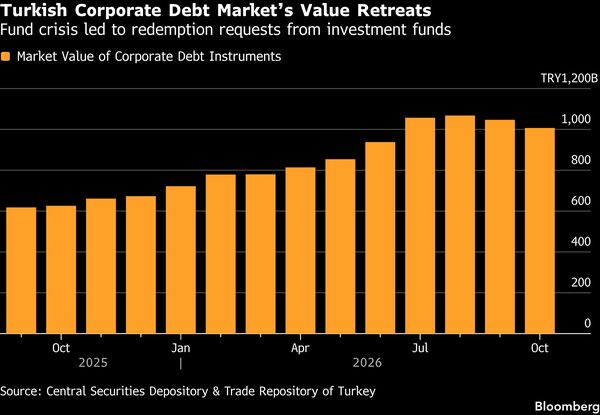
That’s reducing funds’ capacity to take on more risk, investors say, particularly as some asset managers are also exposed to bonds from firms at the center of the crisis. The fallout has been most visible in stocks, wiping billions of dollars off the Istanbul bourse. Yet it’s also posing risks to a market Turkish companies have increasingly tapped in recent years. The lira corporate bond market has expanded 14-fold over the past decade, surpassing one trillion liras as of end-September, according to brokerage Ak Yatirim. Mutual holds hold a third of those volumes. “Most funds are likely to remain cautious on corporate bonds for some time,” said Altan Aydin, a fund manager at Perform Portfoy in Istanbul.
此次危机对股市的冲击最为显著,伊斯坦布尔证券交易所的市值因此蒸发了数十亿美元。不过,近年来土耳其企业日益依赖的企业债券市场同样面临风险。据经纪商Ak Yatirim统计,过去十年间土耳其里拉企业债券市场规模增长了14倍,截至9月底总规模已突破1万亿里拉。其中共同基金占据了三分之一的市场份额。
“Redemptions across the fund industry have forced managers to sell their more liquid assets first, leaving corporate bonds with a larger weight in portfolios. That’s an exposure asset managers are unlikely to want to increase,” Aydin said. He expects smaller companies to bear the brunt, while well-established names should still retain access to the market. A Garanti BBVA unit issued lira debt this month, while several other large entities including Turkcell AS and Akbank TAS raised money with privately placed bonds. Read: How Turkey’s High-Flying Funds Came Crashing Down: Some market players such as Altug Ozaslan, founder of independent advisory firm Fortuna Capital, expect the issuance dip to be temporary. “A few small- to mid-sized firms could be negatively affected by recent developments, but I don’t think this will reach a scale that would have a meaningful impact on the market or the sector as a whole,” Ozaslan said. Even so, there’s still the risk of a spillover from debt that was issued by entities linked to the crisis-hit firms.
“短期内多数基金恐怕都会对企业债券持谨慎态度,”伊斯坦布尔Perform Portfoy基金公司的基金经理阿尔坦·艾丁说道。
About 35 billion liras of such bonds are outstanding, according to data compiled by Bloomberg. While the amounts are small relative to the overall size of the market, funds holding these securities remain exposed to potential non-payment, with the stress potentially seeping into other parts of their portfolios.
“基金行业的大规模赎回迫使管理人优先抛售流动性较强的资产,导致企业债券在投资组合中的占比上升。这种风险敞口显然是资产管理公司不愿进一步扩大的,”艾丁补充道。
That risk came into sharper focus on Oct. 5 when Tera Yatirim Bankasi failed to make 6.05 billion liras worth of principal and coupon payments. On Thursday, market regulators removed Tera Yatirim Menkul’s application to raise a total 69 billion liras in debt, alongside a capital increase. The regulator “prevailing circumstances and existing uncertainties” for the decision.
他预计小型企业将承受最大冲击,而知名度较高的企业仍能顺利进入该市场。本月,Garanti BBVA旗下机构发行了里拉计价债券;Turkcell AS与Akbank TAS等多家大型企业也通过私募方式完成了债券融资。
“Money market and short-term debt instrument funds were among the key buyers of corporate bonds,” said Alp Serbetli, head of Treasury at ICBC Turkey Investment. Should investors need to sell securities to meet redemptions, they could also run into liquidity snags. Turkish regulators have unwound scores of funds in the past month, and assets with limited liquidity accounted for 58.6% of their portfolios, equivalent to about 334 billion liras, a report by brokerage Gedik Yatirim found. “The issue is not the amount of these corporate bonds, but the ability to sell them,” said Omer Gencal, managing partner at Pixis Capital. “Fund outflows are feeding through to corporate bond prices and issuers’ ability to roll over their debt. With no market-making or buyback mechanism in place, the market has a limited buffer.”