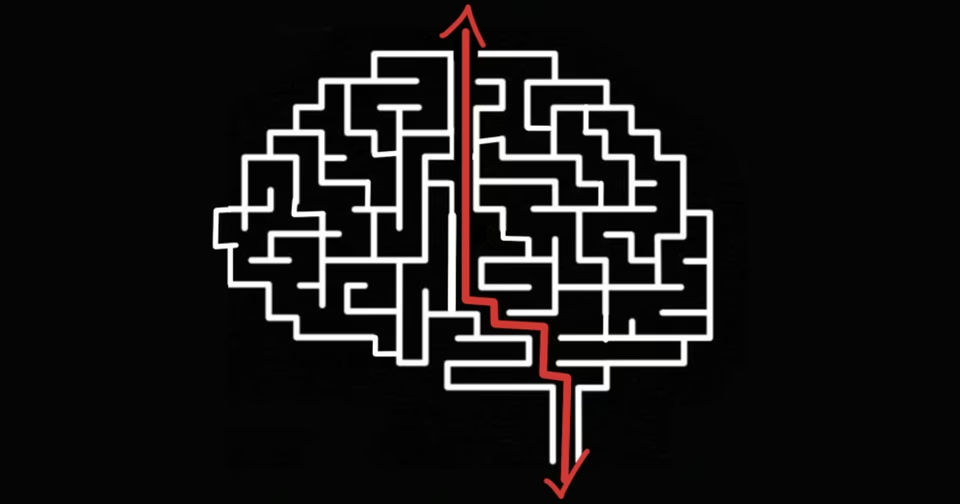
一位知名研究者的煽动性帖子表明,人工智能实际上比我们想象的更具可预测性。
An incendiary post from a prominent researcher suggests that AI is actually more predictable than we thought.
作者:马特奥·翁格 过去24小时,硅谷一直沉迷于人工智能研究者尼克·卡马拉塔的一篇26000字的博客文章。这篇文档被称为“年度最重要的论文”、“年度最重要的成果”和“年度最佳新闻”,甚至在人工智能研究史上——或许是有史以来——最重要的作品。即便是OpenAI首席执行官萨姆·奥尔特曼也对其赞赏有加。卡马拉塔对人工智能的本质提出了一系列大胆、几乎令人惊讶的主张,如果这些主张成立,将颠覆其所在行业对其正在构建的事物的一些基本假设。
By Matteo Wong For the past 24 hours, Silicon Valley has been obsessed with a 26,000-word blog post by the AI researcher Nick Cammarata. The document has been called the “the most important essay,” “the most important result,” and “the single best piece of news” of the year, or in the history of AI research—or, perhaps, ever. Even OpenAI CEO Sam Altman lauded it. Cammarata makes a series of bold, almost astonishing claims about the nature of AI that, if true, would upend some of his industry’s basic assumptions about the very thing it is building.
在经历了数月的人工智能黑客攻击浪潮以及公众对行业日益增长的反弹之后,许多人认为卡马拉塔在理解和控制正被释放到世界上的技术方面提供了一线希望。
And after months of AI-hacking sprees and mounting public backlash against the industry, many people see Cammarata as offering a glimmer of hope when it comes to not just understanding but also controlling the technology being unleashed on the world.
简而言之,卡马拉塔的主要观点是,生成式人工智能模型实际上并不是黑箱,这与普遍认为这些系统如此庞大和错综复杂以至于几乎无法渗透的看法相悖。事实上,卡马拉塔认为,理解它们存在一条相对清晰的路径。如果情况属实,其实际意义可能是巨大的:这将提供一种映射人工智能模型内部运作的方法,进而或许能够防止它们造成各种危害——自主黑客攻击公司和主权国家,鼓励用户产生妄想,甚至欺骗人工智能研究者本身。有一整个研究领域专门致力于此,称为“机制可解释性”。
Boiled down, Cammarata’s main contention is that generative-AI models are not actually black boxes, contrary to the common perception that these systems are so big and labyrinthine as to be nearly impenetrable. In fact, Cammarata argues, there is a relatively clear path toward understanding them. If that’s the case, the material significance could be tremendous: It would provide a way to map AI models’ inner workings and, in turn, perhaps prevent them from wreaking all sorts of harm—autonomously hacking companies and sovereign nations, encouraging users’ delusions, appearing to deceive AI researchers themselves. There is an entire field of research, called “mechanistic interpretability,” devoted to the study of just this.
论点与提出论点的人同样重要。Cammarata 是前 OpenAI 员工,在其领域是备受尊敬的人物。多年前,他在确立一种如今成为常识的相反主张中发挥了关键作用:即神经网络——生成式 AI 所基于的软件架构——是不可能理解的,或者至少非常难以理解。在这篇新文章中,现就职于 AI 研究公司 Goodfire 的 Cammarata 基本上表示,他及其整个领域自那时起一直是错误的。
The argument is just as important as the person making it. Cammarata, a former OpenAI employee, is a respected figure in his field. Years ago, he played a key role in establishing the opposite claim, which is now common wisdom: that neural networks, the software architecture that generative AI is built on, are impossible, or at least very difficult, to understand. In this new essay, Cammarata, who now works at the AI-research company Goodfire, essentially says that he and his entire field have been wrong ever since.
“这里的主张令人震惊,”一位观察者写道。或者正如另一人在 X 上所写的那样,它们是“big big big big”。神经网络受到人类大脑的启发,由单个节点(或称为“神经元”)之间的层级连接组成,当响应查询时,这些节点会激活并相互传递信息。早期研究(包括 Cammarata 的研究)表明,单个机器神经元可以对许多不同且无关的话题作出激活反应——例如,一个神经元可以对应猫脸的图像、猫腿以及汽车前部。
“The claims here are viscerally shocking,” one observer wrote. Or, as another wrote on X, they are “big big big big.”Neural networks, inspired by the human brain, consist of layered connections among individual nodes, or “neurons,” that activate and send information to one another when responding to a query. Earlier research, including Cammarata’s, established that individual machine neurons can activate in response to many different, unrelated topics—for instance, one neuron can correspond to images of cat faces, cat legs, and the front of cars.
当时尚不清楚这是为什么发生的,但一种解释是,由于 AI 模型包含的信息远多于其神经元的数量,它们不得不重新利用这些节点。无论如何,AI 模型的基本单位具有看似任意且众多的功能,这将使得理解其内部运行机制变得非常困难。
Nobody was sure why this happened, but one explanation was that, because AI models contain far more information than they have neurons, they have to repurpose these nodes. Regardless, the basic units of an AI model having seemingly arbitrary, multitudinous functions would make it very difficult to understand what is going on under the hood.
Cammarata 现在认为,单个神经元可以被理解,并且每个神经元都具有自洽的功能。神经网络不是“纠缠的结”,他写道,而是“干净的”。例如,他发现负责猫脸和汽车脸的神经元实际上是在响应具有 V 形的事物——包括 V 形的火焰和水柱。这将使 AI 的内部机制相对直接且可预测,而不是神秘且模糊不清。如果我们能够利用这种理解,行业内的一些人认为,AI 将不太可能失控,比如说,杀死我们所有人。
Cammarata now thinks that individual neurons can be understood and that each has a self-consistent function. Neural networks are not “tangled knots,” he wrote, but “clean.”He found that the cat-face and car-face neuron, for instance, was actually responding to things with a V-shape—including V-shaped flames and jets of water. This would make AI’s internal mechanisms relatively straightforward and predictable rather than mysterious and nebulous. And if we can harness that understanding, some people in the industry believe, AI will be much less likely to go haywire and, say, kill us all.
“这真的是近年来最令人乐观的案例之一!”OpenAI 研究员 Adam Majmudar 在 Not 上写道。并非所有人都同意 Cammarata 的观点。首先,他的 26,000 字仅仅是即将发表的技术论文的“工作假设”,因此在技术层面上难以评估。此外,他研究最深入的神经网络是视觉模型,而视觉模型通常比 ChatGPT 和 Claude 所基于的语言模型更简单、更易理解。
“This is truly one of the greatest cases for optimism in years!” the OpenAI researcher Adam Majmudar wrote on Not everyone agrees with Cammarata. For one, his 26,000 words were merely a “working hypothesis” for a “forthcoming technical paper” and were thus hard, on a technical level, to evaluate. And the neural networks he studied most closely were vision models, which are generally simpler and better understood than the language models underlying ChatGPT and Claude.
Cammarata 可能犯了错误,或者他可能夸大了自己的论点。这篇博客文章没有经过同行评审,而即将发表的论文也很可能不会经过同行评审,因为这是该领域的常态。这项研究本身在某种程度上是一个黑箱。(Cammarata 在未能立即回应置评请求之前,今天早些时候在 X 上写道,他感谢所有的讨论,并且他的方法“到目前为止似乎很有希望”,用于“更大的现代语言模型”。)
Cammarata could be mistaken, or he could be overstating his case. The blog post isn’t peer-reviewed, and the forthcoming paper probably won’t be, either, as is typical in the field. The research itself is something of a black box. (Cammarata, who did not immediately respond to a request for comment, wrote on X earlier today that he appreciates all of the discussion and that his approach “seems promising so far” for “bigger modern language models.”)
对 Cammarata 论文的讨论揭示了哲学上的分歧。“这是有趣的工作,但我不认为这是对大局的重大更新,”谷歌 DeepMind 机械可解释性负责人 Neel Nanda 在他对 Cammarata 研究结果的评价中写道。即使研究人员能够近似 Claude Mythos 5.1 或 GPT-6 Astra 中每个神经元的功能,这也不等同于理解它们如何连接以及网络作为一个整体如何运作。
Discussions of Cammarata’s essay have revealed philosophical rifts. “This is interesting work, but I don’t think it’s a significant update to the big picture,” Neel Nanda, who leads mechanistic interpretability at Google DeepMind, wrote in his appraisal of Cammarata’s findings. Even if researchers could approximate the function of every neuron in Claude Mythos 5.1 or GPT-6 Astra, that’s not the same as understanding how they connect and how the network works as a whole.
物理学家对原子及其相互作用有很好的模型,但他们无法从第一性原理解释或预测每一个物理事件(因此会出现不可预测的极端天气,或者说,自由意志的概念也是如此)。你认识你来自学校、各种工作场所以及当地垒球联盟的所有朋友,但你并不总能知道他们是否会在你的生日派对上相处融洽。更要紧的是,对AI模型内部工作原理的洞察不一定能带来如何让技术更可靠的洞察。可解释性可能是构建更安全AI模型的必要条件,但绝非充分条件。
Physicists have good models of atoms and interatomic interactions, but they cannot from first principles explain or predict every physical event (hence unpredictable extreme weather or, for that matter, the notion of free will). You know all of your friends from school, various workplaces, and the local softball league, but you can’t always know whether they’ll get along at your birthday party. More to the point, insights into the inner workings of an AI model will not necessarily produce insights into how to make the technology more reliable. Interpretability may be necessary to build safer AI models, but it is by no means sufficient.
如果生成式AI模型在内部实际上是可读的,那无疑会有助于让这项技术更安全。但硅谷的许多人,尤其是OpenAI的员工,正以一种令人兴奋不已的热情讨论Cammarata的博客文章,这种热情呼应了硅谷长期以来易于提出技术解决方案和宏大承诺的记录——这种态度掩盖了其在落实方面的参差不齐的表现。
If generative-AI models are actually legible under the hood, that would undoubtedly help make the technology safer. But many people in Silicon Valley, and especially employees at OpenAI, are discussing Cammarata’s blog post with a breathless enthusiasm that echoes Silicon Valley’s long track record of easy technical solutions and grand promises—an attitude that belies its mixed record on following through.
任何与AI安全相关的研究发现都将要求追逐万亿级美元公开发行的行业放慢脚步,认真审视自身。或许比不可理解的超级智能更令人担忧的是,一群公司公开表示他们其实并不真正知道自己在构建什么——但仍然继续将这项技术推向极端。如果Cammarata是正确的,AI公司将不得不彼此合作,邀请外部审计师和政府参与,以弄清楚如何将这样的突破转化为安全可靠的产品。
Any research finding that pertains to AI safety will require an industry chasing multitrillion-dollar public offerings to slow down and take a long, hard look at itself. Perhaps even more concerning than an unintelligible superintelligence is the fact that a group of companies openly state that they don’t really know what they are building—and then continue to push that technology to extremes anyway. If Cammarata is correct, AI companies will have to work with one another, outside auditors, and governments to figure out how to translate such a breakthrough into safe and reliable products.
而目前,在没有任何严格监管的情况下,除了这些公司自身之外,没有人能决定采取这样的行动。所有这些都表明,真正的黑箱恰恰是OpenAI和Anthropic自身。
And right now, absent any serious regulation, nobody can decide to take such action other than the companies themselves. All of which suggests that the real black boxes are OpenAI and Anthropic themselves.