中国企业已成为全球人工智能贸易放缓的最大受害者,这对北京利用股市推动其技术霸权雄心的努力构成挫折。
Chinese firms have emerged as the biggest losers of the faltering global AI trade, a setback for Beijing’s efforts to use stock markets to supercharge its ambition of technological supremacy.
类似纳斯达克的星50指数在今年上半年暴跌近40%,成为全球表现最差的主要科技指标。主要芯片制造商MetaX集成电路上海有限公司和摩尔线程科技有限公司在此期间均损失了约一半的市值。同样侧重于硬件股票的创业板指数也下跌了36%。
The Nasdaq-style Star50 Index has tumbled nearly 40% in the current half year, becoming the world’s worst-performing major tech gauge. Major chipmakers MetaX Integrated Circuits Shanghai Co. and Moore Threads Technology Co. have both shed around half of their value during this period. The ChiNext index, similarly focused on hardware stocks, has lost 36%.
这标志着今年早些时候的局面出现逆转——当时星50指数因投资者忽视高估值、押注北京的政策推动并搭乘全球人工智能热潮而出现惊人反弹。如今,随着对未来需求和盈利前景的审查加剧,中国股票受到的冲击最为严重,所有热情随之消散。鉴于中国企业对股权融资的依赖程度更高,这一发展令人担忧。
It marks a reversal of fortunes from earlier this year, when the Star50 enjoyed a stunning rally as investors ignored frothy valuations to bet on Beijing’s policy push and ride the global AI boom. All that enthusiasm has since unraveled as scrutiny of future demand and earnings prospects hit Chinese stocks the hardest, a worrisome development given the heavier reliance on equity financing by the country’s firms.
“如果科技股长期承压,中国实现其人工智能雄心将变得更加困难,”高瓴资本投资组合经理列昂尼德·米罗诺夫表示。“如果疲弱态势持续超过六个月,这将使融资变得困难,也意味着市场对所取得的技术进步不感兴趣。”星50指数在4月至6月期间曾飙升约75%,超越韩国的KOSPI,原因是市场对中国企业的技术突破和强有力的国家支持持乐观态度。该指数在6月30日的峰值时市盈率超过80倍。但随着市场情绪骤然转变,该行业的高估值已成为负担。
“It would be much harder for China to achieve its AI ambitions if technology stocks remain under pressure for an extended period,” said Leonid Mironov, a portfolio manager at Gavekal Capital. “If the weakness goes on for more than six months, this will make fundraising difficult and also imply that the market is unimpressed with the technological progress being achieved.”The Star50 surged around 75% between April and June — beating Korea’s Kospi — on optimism about Chinese firms’ technological breakthroughs and strong state support. The gauge traded at over 80 times forward earnings at its peak on June 30. Yet as sentiment abruptly turned, the sector’s high valuations have become a liability.
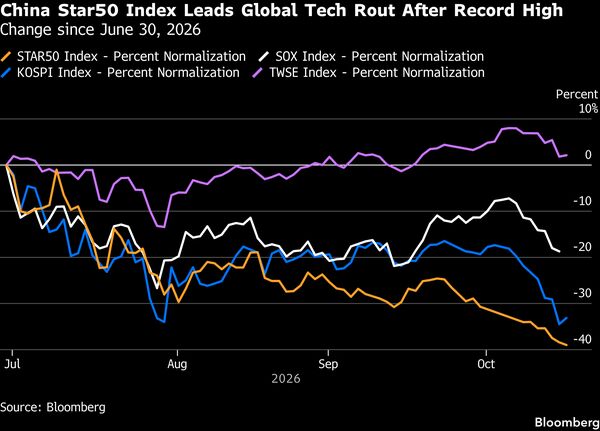
“全球人工智能硬件抛售潮——覆盖纳斯达克和韩国——在外国投资者于第二季度涌入该板块后,对中国A股的冲击最为严重,”彭博智库分析师杰森·廖和马文·陈在一份报告中写道,指的是中国境内股票。
“The global AI-hardware selloff, spanning the Nasdaq and Korea, hit China A-shares hardest after foreign investors crowded into the sector in 2Q,” Bloomberg Intelligence analysts Jason Liao and Marvin Chen wrote in a note, referring to China’s onshore equities.
一份报告称,通过沪港通与香港的交易通道流出的资金,在第三季度总计约900亿元人民币(135亿美元),为一年来最大规模,并逆转了四月至六月期间超过一半的资金流入。
Outflows from a trading link with Hong Kong that allows foreign investors access to Chinese local stocks totaled an estimated 90 billion yuan ($13.5 billion) in the third quarter, the biggest in a year and reversing more than half of the inflows between April and June, the note says.
最近的抛售也给中国一些最热门的交易首秀带来了压力。存储芯片巨头长江存储科技(CXMT Corp.)于七月上市,其股价已从上市后的高点下跌27%。同样,机器人公司宇树科技(Yushu Technology Co.)自八月首次公开募股后不久的高点以来,已下跌约50%。
The recent selloff has also weighed on some of China’s hottest trading debuts. Memory-chip giant CXMT Corp., which went public in July, has fallen 27% from its post-listing peak. Similarly, robotics firm Yushu Technology Co., has lost around 50% from an August high shortly after its initial public offering.
彭博社汇编的数据显示,中国公司今年通过境内首次公开募股(IPO)共筹集370亿美元,使年度募资额达到三年来最高。科技公司占筹集资金的三分之一以上。
Chinese companies have fetched a combined $37 billion from onshore IPOs this year, lifting annual proceeds to their highest in three years, according to data compiled by Bloomberg. Tech firms accounted for over a third of the funds raised.
中国科技股的表现不佳,对渴望利用资本市场推动企业增长的当局构成了挑战。该国的人工智能相关国家冠军企业和初创公司显示出对股权融资的偏好高于债务融资,这在一定程度上反映了它们在全球发行债券的成本较高。
The underperformance of China’s tech stocks poses a challenge for authorities that are keen to use capital markets to fuel the firms’ growth. The country’s AI-linked national champions and startups have shown a stronger preference for equity financing over debt, partly reflecting the higher costs for them to issue bonds globally.
米罗诺夫表示,股票是中国人工智能公司“默认的”资金来源。“如果低迷持续,将会产生影响,北京可能需要更积极地推动金融部门改革,并可能更积极地部署‘国家队’,”他指的是监管机构用于稳定市场的一组国家支持基金。
Equities are “the default source” of funding for China’s AI firms, according to Mironov. “If the slump is prolonged it will have an impact and Beijing may need to be more proactive in expediting financial sector reforms and potentially deploying the national team more aggressively,” he said, referring to a group of state-backed funds used by regulators to stabilize markets.
不过,如果政府大幅加大力度支撑低迷的市场,局势可能会发生转变。金融监管机构周四召开会议,讨论稳定措施,并呼吁“国家队”加速购买股票。即将到来的第三季度财报季可能带来的任何惊喜,也可能有助于改善市场情绪。
To be sure, the tide may shift if the government significantly increases efforts to prop up the languishing market. Financial regulators held a meeting Thursday to discuss stabilization measures and called on the national team to accelerate stock purchases. Any pleasant surprises from the upcoming third-quarter earnings season may also help brighten the mood.
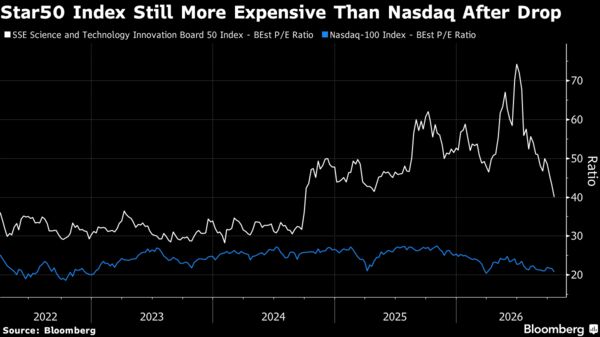
然而,一些投资者对前景持怀疑态度,因为即使在最近的抛售之后,中国的人工智能相关股票仍然偏贵。星50指数目前的市盈率超过40倍。相比之下,韩国综合指数的市盈率低于5倍,纳斯达克100指数的市盈率为21倍。
Still, some investors are skeptical about the outlook because China’s AI-related stocks remain expensive even after the recent selloff. The Star50 now trades at over 40 times forward earnings. It compares with less than five times for South Korea’s Kospi Index and 21 times for the Nasdaq 100.
“目前的水平代表技术性回调,而非价值投资机会,”Gam Investment Management基金经理Jian Shi Cortesi表示。“对于许多高潜力科技股票,要等到它们再下跌30%-50%时,才可能出现真正的低价买入机会。”
“Current levels represent a technical pullback, not a value play,” said Jian Shi Cortesi, a fund manager at Gam Investment Management. “For many high-potential tech names, big bargains won’t appear until they fall another 30%-50%.”