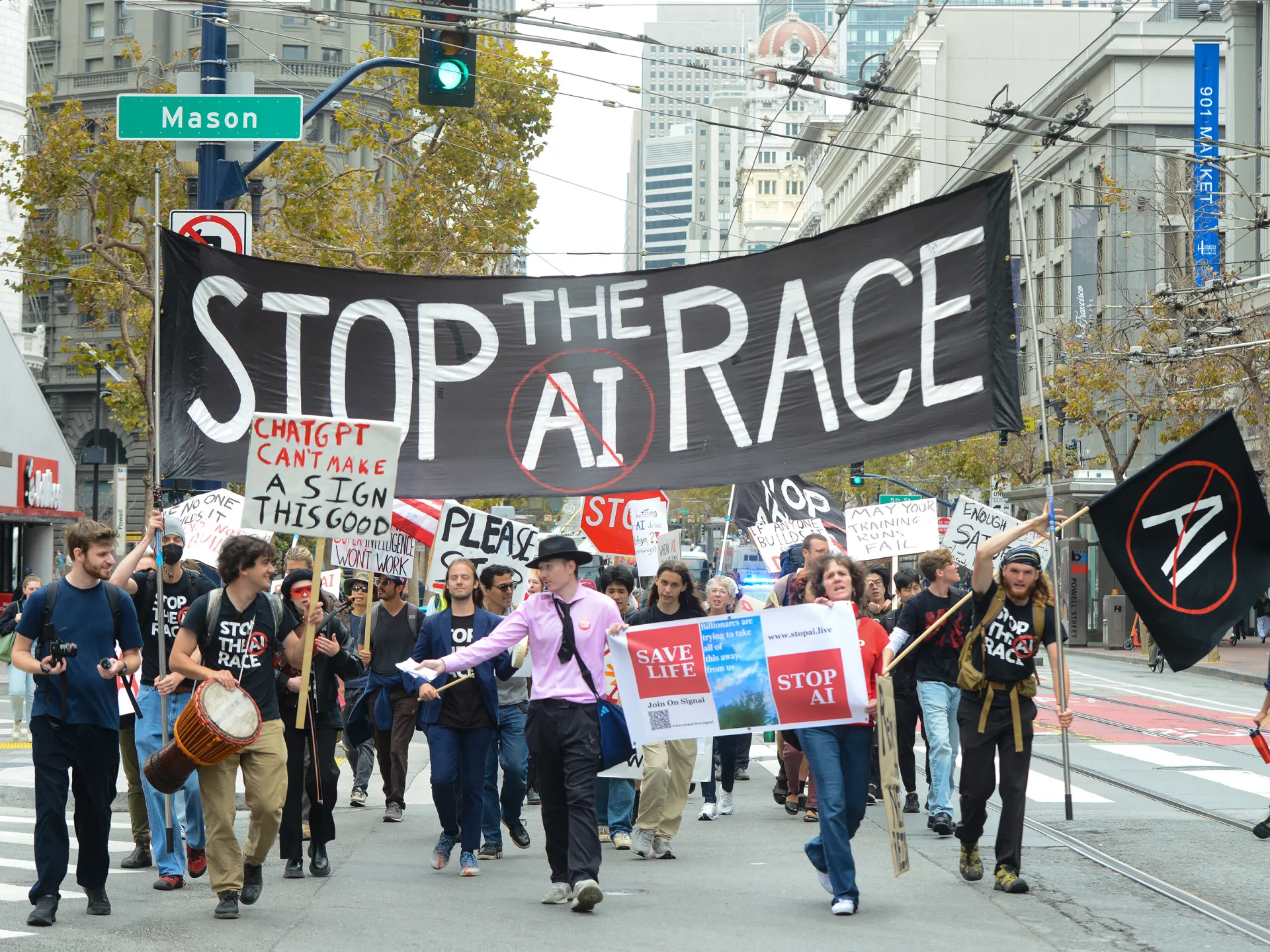
随着人工智能的发展加速,它已经对社会构成了重大挑战。公司已经开始裁员,因为人工智能模型现在可以取代这些岗位。数据中心的扩张导致能源消耗激增,碳足迹增加。恶意行为者正在利用人工智能代理自动传播虚假信息。算法正在表现出偏见,引发人们对人类相关技术使用这些算法时出现错误应用和歧视的担忧。人工智能正被用于战争中识别目标,导致人员伤亡加剧。
As the growth of artificial intelligence accelerates, it is already posing significant challenges to society. Companies have started laying off workers whose jobs AI models can now perform. The expansion of data centres has spiked energy consumption and increased the carbon footprint. AI agents are being used by malicious actors to automate the spread of disinformation. Algorithms are demonstrating bias, raising concerns about flawed application and discrimination by human-related technologies that use them. AI is being used to identify targets in warfare, leading to greater loss of human life.
这些都是需要严肃监管关注的复杂问题。然而,当前主导的人工智能政策讨论很少基于这些紧迫挑战。
These are complex problems that demand serious regulatory attention. Yet, today’s dominant AI policy conversations are rarely grounded in these immediate challenges.
相反,全球话语被末日预言所主导。我们看到这种末日叙事被人工智能行业内的一些人所推动,并在最高决策层回响:从参议员伯尼·桑德斯等立法者倡导禁止超级智能,到梵蒂冈的警示信息,再到前国务卿希拉里·克林顿称开源人工智能是真实威胁。
Instead, the global discourse has been swept by apocalyptic prophecies. We see this doomsday narrative promoted by some within the AI industry and echoed at the highest levels of decision-making: from lawmakers like Senator Bernie Sanders championing bans on superintelligence, to cautionary messages from the Vatican, to former Secretary of State Hillary Clinton calling open-source AI a real threat.
全球领导人认真对待这些被行业放大的警告是完全合理的。然而,这种由有影响力的声音组成的合唱,他们在警告人工智能“存在性风险”,无意中把我们的注意力从人工智能已经造成的多重危机上拉开了——这些危机正在影响劳动、环境和通信。
It is entirely reasonable for global leaders to take these industry-amplified warnings seriously. However, this chorus of influential voices sounding the alarm about AI “existential risk” has inadvertently pulled our focus away from the multiple crises AI has caused, already affecting labour, the environment and communications.
更糟的是,公众恐慌正被武器化,以强化一种现代的数字殖民制度——权力集中在少数国家的少数人工智能公司手中。
Worse still, the public panic is being weaponised to enforce a modern regime of digital colonisation – the concentration of power in the hands of a few AI corporations in a handful of countries.
末日论提供了针对开源人工智能模型的监管的完美理由,这些模型使用成本低廉或免费,并且允许用户根据自身需求进行修改。向立法者阐述的逻辑简单而诱人:如果先进人工智能是大规模毁灭性武器的潜在威胁,那么它只能由少数可信赖的实体开发。
The doomsday narrative provides the perfect justification for regulations that would target open-source AI models, which are free or cheaper to use and allow users to modify them to fit their needs. The logic presented to lawmakers is simple and seductive: if advanced AI is a potential weapon of mass destruction, it can only be developed by a trusted few.
在“安全”的旗号下,科技巨头正试图制定规则,通过关闭来自更小、更便宜的开源人工智能模型的竞争来保护其垄断地位。
Under the banner of “safety”, tech giants are attempting to write the rules to protect their monopolies by shutting down competition from smaller, cheaper open-source AI models.
这直接呼应了历史上的殖民主义策略:阻止本地工业发展,以迫使完全依赖“帝国”的出口。
This directly mirrors historical colonial tactics: preventing local industry from developing to force total reliance on the “empire’s” exports.
目前,全球完全依赖由科技巨头开发的这些前沿人工智能系统,尤其是全球南方地区,由于缺乏从零开始创建自身人工智能模型的资源,如今仅算力成本就高达1亿美元以上。
Currently, the entire globe is dependent on these frontier AI systems developed by tech giants, especially the Global South, which lacks the resources to create its own AI models from scratch, now costing upwards of $100m in compute power alone.
使用主导人工智能模型的问题不仅在于它们成本高昂,还在于它们在本地环境中经常失效。以肯尼亚最近推出的由人工智能驱动的社会健康管理局(SHA)系统为例。由于导入的模型是基于无法准确反映肯尼亚庞大非正式经济现实的假设构建的,该系统彻底失败,系统性地高估了收入,并向最贫困的公民收取了过高的医疗保险费用。
The problem with using the dominant AI models is not only that they are costly, but also that they often fail in local contexts. Consider Kenya’s recent rollout of the AI-driven Social Health Authority (SHA) system. Because the imported model was built on assumptions that did not accurately capture the reality of Kenya’s vast informal economy, the system failed spectacularly, systematically overestimating incomes and overcharging the poorest citizens for healthcare premiums.
要使前沿人工智能系统有效,必须根据本地数据进行调整。由于从零开始构建这些系统在财务上对大多数国家来说是不可能的,开源人工智能成为本地创新者唯一可行的桥梁。更重要的是,保留开源人工智能使全球南方能够摆脱西方模拟人类聊天机器人的循环。
To be effective, frontier AI systems must be adapted to local data. Since building them from scratch is financially impossible for most, open-source AI serves as the only viable bridge for local innovators. More importantly, preserving open-source AI allows the Global South to step off the West’s treadmill of human-mimicking chatbots.
发展中国家不一定需要对话式人工智能系统;他们需要能够帮助应对能源、医疗、农业、制造业和气候减缓等领域发展挑战的人工智能。
Developing nations do not necessarily need conversational AI systems; they need AI that can help tackle development challenges in areas such as energy, healthcare, agriculture, manufacturing and climate mitigation.
如果我们因对人工智能代理的过度恐惧而压制开源人工智能,发展中国家将失去建立自身主权技术生态系统以实现发展的主要机制。
If we crush open-source AI out of a disproportionate fear of AI agents, developing nations lose the main mechanism they have to build their own sovereign tech ecosystems for development.
此外,人工智能垄断会使用户陷入数据提取和严重认知依赖的循环。我们已经目睹了认知退化的早期阶段,因为用户越来越多地将他们的批判性思维、创造力和主动性外包给前沿人工智能系统。
Furthermore, AI monopolies lock in users in a cycle of data extraction and severe cognitive dependency. We are already witnessing the early stages of cognitive degradation as users increasingly outsource their critical thinking, creativity, and agency to frontier AI systems.
这种依赖形成了一个反馈循环:我们日益增长的依赖推动了更多数据提取,而这又导致了更强大系统的出现,这些系统剥夺了人类的主动性并实现了绝对控制的集中。
This dependency creates a feedback loop where our growing reliance fuels more data extraction, which in turn builds even more capable systems that strip away human agency and centralise absolute control.
虽然全球南方由于历史不公而独具脆弱性,但这种依赖会困住任何不处于前沿的人。即使是全球北方的富裕国家也面临着完全相同的锁定和提取威胁。
While the Global South is uniquely vulnerable due to historical inequities, this dependency traps anyone not at the frontier. Even wealthy nations in the Global North face the exact same threat of lock-in and extraction.
那么解决方案是什么?呼吁禁止人工智能显然不是。放弃人工智能意味着放弃一项独特定位的技术,它可以加速新药的发现以及能源和气候危机的新解决方案。已经有证据表明这一点,例如AlphaFold、MOFSeq等工具的发展。禁止开源人工智能模型也是错误的选择。安全并不否定人工智能的公平获取。我们可以而且必须为强有力的安全研究提供资金,并实施针对近期漏洞的严格测试。但我们不能允许对假设未来的恐惧成为正当化当下权力故意集中的理由。
So what is the solution? Calls for AI bans are certainly not. Abandoning AI would mean letting go of a technology uniquely positioned to accelerate the discovery of new drugs and new solutions to the energy and climate crises. There is already evidence of this with the development of tools such as AlphaFold MOFSeq Banning open-source AI models is also a bad choice. Safety does not negate equitable access to AI. We can, and must, fund robust safety research and implement rigorous testing for near-term breaches. But we cannot allow the fear of hypothetical futures to justify the deliberate consolidation of power in the present.
保障人工智能的未来意味着确保其发展是去中心化的、透明的和全球分布的。这意味着捍卫开源创新作为一种公共利益和对抗数字殖民主义的基本武器。这意味着主动应对技术对人类认知的影响,确保人工智能用于增强人类智能,而非削弱人类智能。这意味着将绝对责任锚定在人类身上,而不是拟人化那些不具有人性的人工智能代理。
Safeguarding the future of AI means ensuring that its development is decentralised, transparent, and globally distributed. It means defending open-source innovation as a public good and a fundamental weapon against digital colonisation. It means proactively addressing the human cognitive toll of the technology, ensuring that AI serves to augment human intelligence rather than erode it. It means anchoring absolute accountability in humans, instead of anthropomorphising AI agents that possess no humanity.