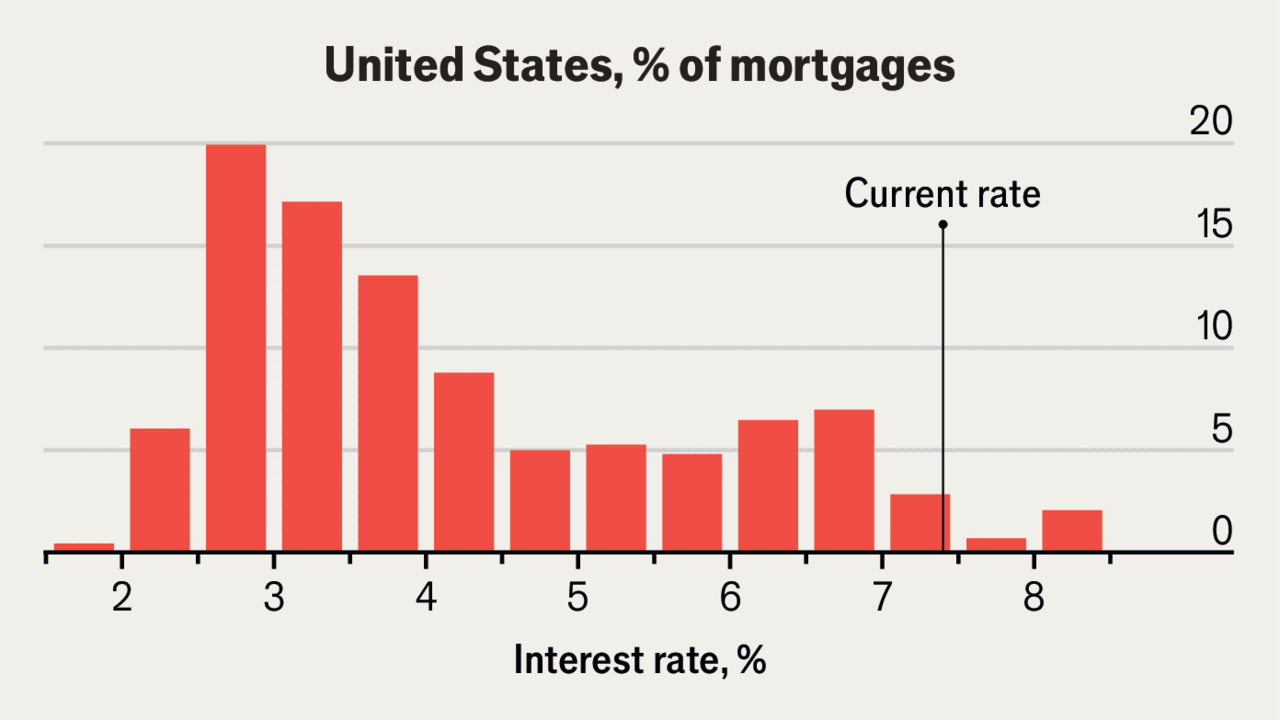
尽管美国经济大部分领域依然火热,但房地产市场却陷入冻结。高企的抵押贷款利率是主要原因。10月15日,政府支持的抵押贷款买方房利美(Freddie Mac)报告称,30年期固定利率平均值为7.4%,仅略低于其25年高点7.8%。许多有志购房者买不起房:首次购房者目前约占购房总量的30%,而1990年代和2000年代这一比例超过40%。
ALTHOUGH MUCH of the American economy is running hot, the housing market is in a freeze. High mortgage rates are largely to blame. On October 15th Freddie Mac, a government-backed mortgage buyer, reported that the average 30-year fixed rate was 7.4%, just shy of its 25-year high of 7.8%. Many aspiring homeowners cannot afford to get on the ladder: first-time buyers now account for roughly 30% of purchases, compared with more than 40% in the 1990s and 2000s.
现有房主不愿出售,因为搬家意味着要用更昂贵的贷款置换现有的低息贷款。我们的分析表明,如果利率维持在7.4%,这种“锁定”效应可能会阻碍原本会发生的五分之一的交易。
Existing owners do not want to sell, since moving would mean swapping a cheap mortgage for a dearer one. If rates stay at 7.4%, our analysis suggests, this “lock-in” effect could prevent a fifth of sales that would otherwise have taken place.
锁定效应在很大程度上是美国独特抵押贷款制度的后果。贷款机构通常提供30年期固定利率贷款。在大多数其他富裕国家,购房者借款采用浮动利率,或固定两年、五年或十年的利率。即使长期固定利率很常见(如在法国),借款人在利率下降时重新融资往往也要支付罚金。美国人重新融资的成本相对较低,这使他们能在利率低时锁定廉价贷款,并在利率上升时继续持有。
Lock-in is largely a consequence of America’s peculiar mortgage system. Lenders typically offer 30-year loans at fixed rates. In most other rich countries homebuyers borrow at variable rates or at rates fixed for two, five or ten years. Even where long fixes are common, as in France, borrowers are often charged a penalty to refinance when rates fall. Americans can do so at relatively little cost, allowing them to secure cheap loans when rates are low and hold onto them when rates rise.
但与英国和加拿大的借款人不同,美国人通常无法将抵押贷款“转移”到新房产,迫使持有低息贷款的人在搬家时不得不承担更高的利率。
But, unlike borrowers in Britain and Canada, Americans cannot generally “port” their mortgages to a new property, forcing those with cheap loans to pay higher rates when they move.
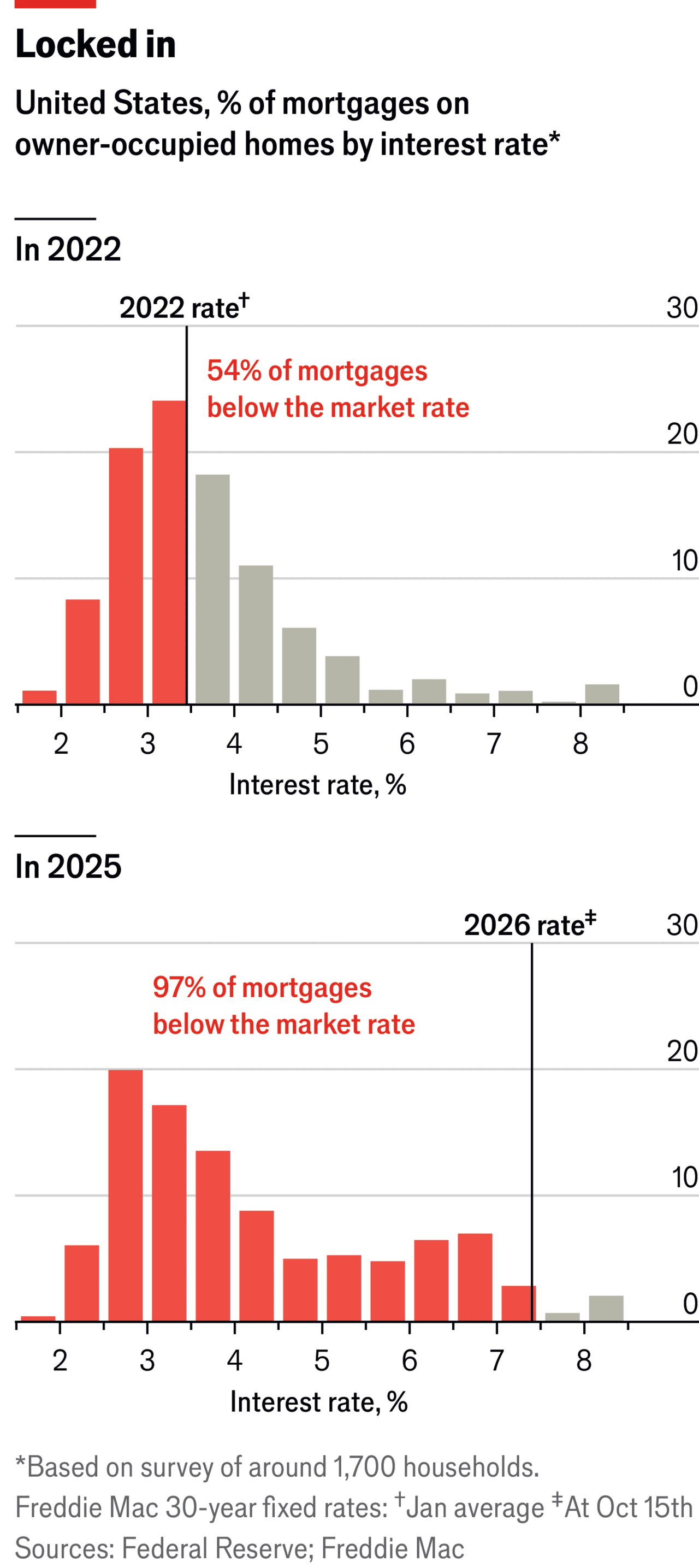
只有现在,抵押贷款“锁定效应”才成为一个严重问题。在其他最近的货币紧缩周期中——包括1987-1989年、1994-1995年、1999-2000年以及2015-2018年——抵押贷款利率在反转前上升了1至2.5个百分点,通常在六个月内。其中最严重的可能是1999-2000年,当时利率在前一个低点以上至少一个百分点的水平维持了18个月。
Only now has mortgage lock-in become a serious problem. In other recent monetary-tightening cycles—including in 1987-89, 1994-95, 1999-2000 and 2015-18—mortgage rates rose by 1-2.5 percentage points before reversing course, usually within six months. The worst of those episodes was probably 1999-2000, when rates remained at least one point above their previous low for 18 months.
相比之下,这一次利率上升了近五个百分点,并维持高位超过四年。在以往的周期中,拥有比现行利率至少低一个百分点抵押贷款的借款人比例不超过40%。如今这一比例为87%,且76%的借款人支付的利率至少低两个百分点。
This time, by contrast, rates have risen by nearly five points, and stayed high for more than four years. In previous cycles no more than 40% of borrowers had mortgages even one point below the prevailing rate. Today 87% do, and 76% pay at least two points less.
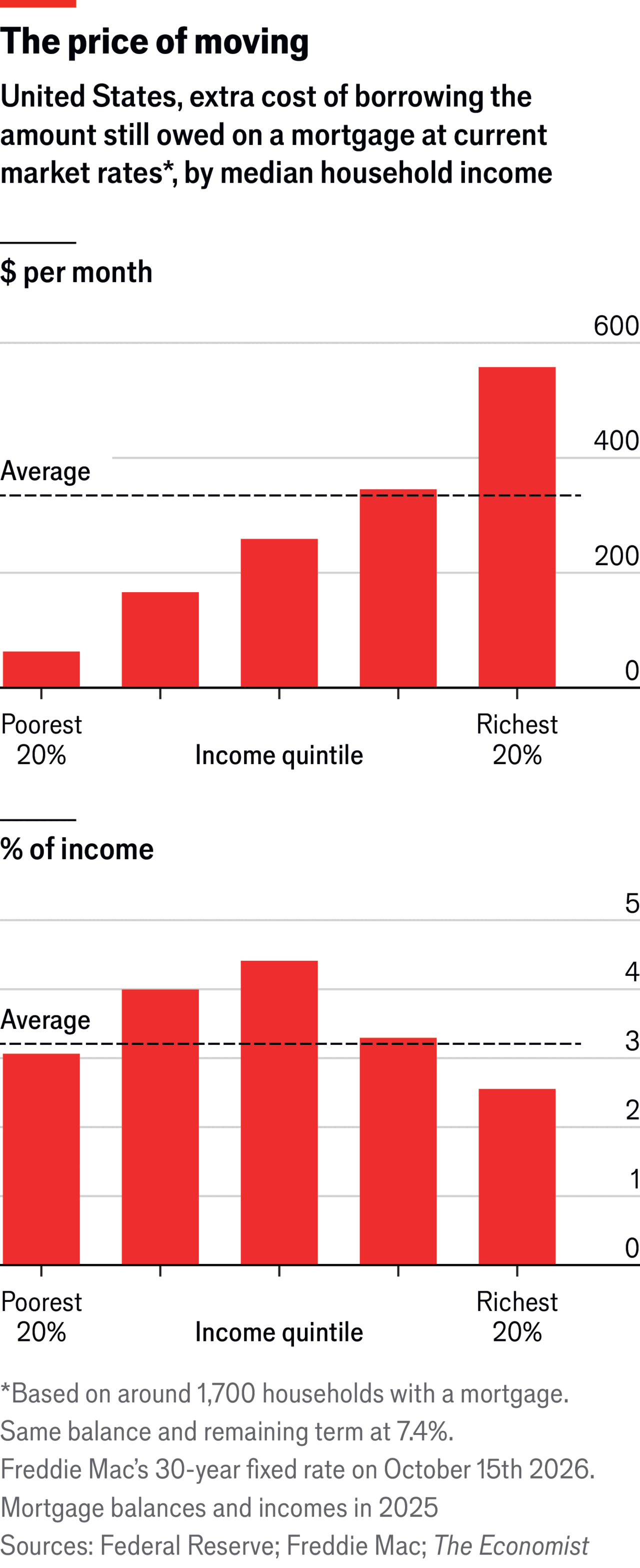
搬家对现有抵押贷款持有者来说成本几何?为了弄清这一点,《经济学人》分析了美联储最新《消费者财务调查》的数据。该调查每三年进行一次,涵盖约1700名抵押贷款借款人。利用他们的收入、未偿还余额、贷款剩余年限及利率,我们估算典型借款人若出售房产并按当今7.4%的市场利率购买一套同等住房,每月将额外支付335美元利息,占税前家庭收入的3.2%。
How much does moving cost existing mortgage-holders? To find out, The Economist analysed data from the Federal Reserve’s latest Survey of Consumer Finances. Conducted every three years, it includes some 1,700 mortgage borrowers. Using their incomes, their outstanding balances, the number of years left on their loans and their interest rates, we estimate that the typical borrower would pay an extra $335 a month in interest, or 3.2% of their pre-tax household income, to sell their home and buy an identical one at today’s market rate of 7.4%.
就美元金额而言,收入最高的五分之一群体面临的账单最大(558美元),但相对于收入,中等收入者受冲击最重(占收入的4.4%)。
In dollars, mortgage-holders in the top fifth of earners would face the biggest bill ($558) but, relative to income, middle earners would be hit hardest (4.4% of income).
这种成本让美国人不愿搬家,即使搬家原本是值得的——比如为了找份更好的工作,或者为不断壮大的家庭买套更大的房子。联邦住房金融管理局(FHFA,一家监管机构)前经济学家今年发表的一篇论文估计,市场利率与借款人现有利率之间的差距每扩大一个百分点,出售房屋的可能性就会降低18%。作者推算,在2022年第二季度至2024年同期利率处于4.7%至7.8%区间期间,“锁定效应”阻止了170万笔房屋交易。
Such costs discourage Americans from moving, even when doing so would otherwise be worthwhile—for a better job, say, or to buy a bigger home for a growing family. A paper published this year by former economists from the Federal Housing Finance Agency (FHFA), a regulator, estimates that every percentage-point increase in the gap between market rates and a borrower’s existing one reduces the likelihood of selling by 18%. The authors reckon that lock-in prevented 1.7m home sales between the second quarter of 2022 and the same period in 2024, when rates were 4.7-7.8%.
按当前7.4%的利率测算,我们估计“锁定效应”每年可能让近100万笔交易不再发生,约占原本本应成交数量的五分之一。
At today’s rate of 7.4%, we estimate that lock-in could discourage nearly 1m sales each year, roughly a fifth of those that would otherwise take place.
“锁定效应”也可能在推高房价。经济学常识表明,较低利率通过让买家能借更多钱从而推高房价,而较高利率则效果相反。但“锁定效应”使这种关系变得复杂。它阻碍持有低息房贷的房主出售,减少了市场上的房源供给,从而对房价形成上行压力。FHFA经济学家估计,在2022年第二季度至2024年同期,较高利率使房价下降了5.6%,但由此产生的“锁定效应”却将房价推高了7%。净效应是让房价变得更高。
Lock-in may also be pushing up house prices. Economics 101 suggests that lower rates boost house prices by allowing buyers to borrow more, whereas higher rates have the opposite effect. But lock-in complicates this relationship. By discouraging homeowners with cheap mortgages from selling, it reduces the supply of homes on the market, putting upward pressure on prices. The FHFA economists estimate that between the second quarter of 2022 and the same period in 2024 higher rates pushed down house prices by 5.6%, but the resulting lock-in pushed them up by 7%. The net effect was to make homes more expensive.
怎么办?让房贷可承接(允许买家接手卖家的贷款)或可转移(允许房主将房贷转移到新房产)可能会有所帮助。FHFA表示正在评估这两个想法。但此类改革主要惠及未来的借款人,对已被“锁定”的人帮助不大。对他们而言,唯一真正的解决办法是房贷利率大幅下降。而就目前来看,那似乎还很遥远。■
What to do? Making mortgages assumable (allowing buyers to take over a seller’s loan) or portable (allowing homeowners to transfer their mortgage to a new property) could help. The FHFA says it is evaluating both ideas. But such reforms would largely benefit future borrowers, doing little for those already locked in. For them, the only real solution is a substantial fall in mortgage rates. And, for now, that looks a long way off.■