智利的老化铜矿因致命事故、极端天气和运营失误而受到重创,引发人们对全球最大铜生产商能够多快从二十多年来最低产出中恢复的质疑。
Chile’s aging copper mines have been battered by deadly accidents, extreme weather and operational missteps, raising questions over how quickly the world’s biggest producer can recover from its lowest output in more than two decades.
过去一个月,智利矿井至少有七名工人死亡,其中包括在科德尔科(Codelco)的埃尔特尼恩特(El Teniente)作业区发生雪崩导致的两人死亡。暴雨和暴雪反复扰乱矿井和基础设施,而劳资紧张关系持续升温,即使安托法加斯塔(Antofagasta Plc)矿区工人结束罢工、必和必拓(BHP Group)在埃斯康迪达(Escondida)— — 全球最大铜矿 — — 勉强避免罢工,也不确定因素仍在增加。
At least seven workers have died at Chilean mines in the past month, including two in an avalanche at Codelco’s El Teniente operation. Severe rain and snow have repeatedly disrupted mines and infrastructure, while simmering labor tensions are adding another layer of uncertainty even after workers at an Antofagasta Plc mine ended a strike and BHP Group narrowly averted a walkout at Escondida, the world’s largest copper mine.
这些问题正值交易商、生产商和投资者聚集伦敦参加LME周之际显现,届时矿产供应疲软很可能成为关键议题,因为与会者将就2027年的合同进行谈判。
The troubles are playing out as traders, producers and investors gather for LME Week in London, where faltering mine supply is likely to be a key topic as participants negotiate contracts for 2027.
尽管与关税相关的贸易流动一直是今年铜价创纪录上涨的主要驱动力,但矿业问题也是另一个关键因素,尤其是智利,其占全球开采供应的比重超过20%。这些挫折增加了全球矿产输出自2017年以来首次出现年度下降的可能性 — — 就在数据中心和电网扩张带来的需求加速增长之时。
While tariff-related trade flows have been the main driver of record copper prices this year, mining problems are another critical factor, particularly in Chile, which accounts for more than 20% of global mined supply. The setbacks are increasing the likelihood of the first annual decline in global mine output since 2017 — just as demand from data centers and power-grid expansion accelerates.
最近的极端天气频发暴露出一个长期困境:智利铜矿业长期建立在历史上干旱的条件之上。这也为未来提供了一个窗口:随着强烈的厄尔尼诺现象发展,矿井和基础设施可能面临怎样的考验。夏季气温升高可能导致高海拔作业区的冰体移动,威胁到采坑稳定性和运输路线。
The recent spate of extreme weather is exposing a longer-term dilemma for an industry built around Chile’s historically arid conditions. It also offers a glimpse of what could lie ahead for mines and infrastructure as a powerful El Niño develops. Higher summer temperatures risk causing ice masses to shift at high-altitude operations, threatening pit stability and transport routes.
“气候变化显然在起强烈作用,而采矿业的适应能力有限,”智利铜研究中心塞斯科(Cesco)研究主管克里斯蒂安·西富恩特斯(Cristian Cifuentes)表示。
“There’s clearly a strong influence from climate change and the mining sector’s limited ability to adapt,” said Cristian Cifuentes, head of research at Chilean copper-study center Cesco.
天气干扰正叠加在更根本的障碍之上。智利的巨型矿山正在老化;露天矿坑越来越深,矿石品位下降,这意味着公司必须搬运和处理更多材料才能生产出同样数量的铜。杰富瑞分析师估计,智利露天矿每年因自然原因的产量下降约为2%,而最近的投资不足以抵消这一下降。
Weather disruptions are landing on top of more fundamental hurdles. Chile’s giant mines are growing older; pits are getting deeper and ore quality is deteriorating, meaning companies have to move and process more material to produce the same amount of copper. Jefferies analysts estimate Chilean open pits experience about a 2% annual natural production decline, with recent investment not enough to offset it.
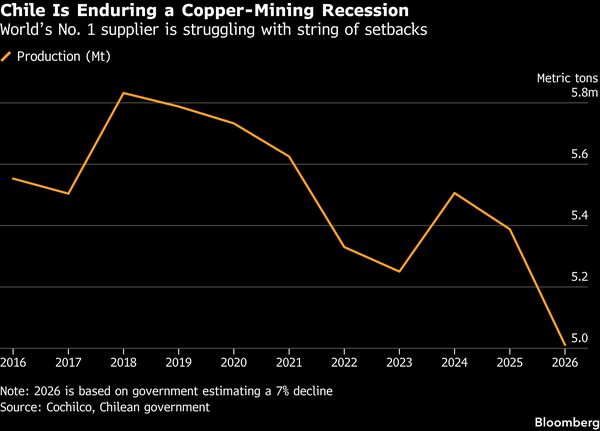
智利财政部长豪尔赫·奎罗斯在9月表示,智利正处于“主要的采矿衰退”中。他预计今年产量将下降约7%,随后在2027年部分复苏。如此幅度的下降将使产量降至约500万吨,这是自2003年以来的最低年度水平。当时全球需求大约低45%,而智利占世界开采铜产量的三分之一以上,正值中国大宗商品繁荣的黎明时期。
Chile is in a “major mining recession,” Finance Minister Jorge Quiroz said in September. He expects output to fall about 7% this year before partially recovering in 2027. A decline of that magnitude would put production at roughly 5 million metric tons, the lowest annual level since 2003. Back then, global demand was about 45% lower and Chile accounted for more than a third of the world’s mined copper, just as China’s commodities boom was dawning.

十年前,智利国有铜委员会Cochilco估计,如果在建项目得以实现,该国到2025年有潜力生产850万吨铜。即使在2022年,该机构也预测2025年产量将达到640万吨。然而,新项目和扩建项目反复未能抵消品位下降和矿山老化的影响。
A decade ago, the Chilean state copper commission Cochilco estimated the country had the potential to produce 8.5 million tons by 2025, if projects in the pipeline were realized. Even in 2022, the agency was forecasting 6.4 million tons for 2025. Instead, new projects and expansions have repeatedly failed to offset declining grades and maturing mines.
目前对今年情况有多严重以及产量能多快恢复存在相当大的争议。Cochilco预测今年产量将下降2.6%,随后在2027年反弹5.2%;而咨询公司CRU集团准备将其对约3%下降的预测下调至更接近5%的水平,分析师尼古拉斯·穆尼奥斯表示。CRU预计,鉴于大型新项目的短缺,智利要到2030年才能恢复到600万吨的产量水平。
There’s considerable debate over how bad this year will be and how quickly production can recover. Cochilco forecasts a 2.6% decline this year before a 5.2% rebound in 2027, while consultant CRU Group is set to lower its forecast for a roughly 3% drop to something closer to 5%, analyst Nicolas Muñoz said. CRU expects it will take until 2030 for Chile to return to 6 million tons, given the shortage of large new projects.
“我们并不是因为悲观才这样说,而是因为我们没有技术依据”来期待更快的复苏,穆尼奥斯说。
“It’s not because we are pessimistic, it’s because we don’t have a technical reason” to expect a faster recovery, Muñoz said.
科德尔科(Codelco)是问题的核心。这家国有生产商正努力稳定产量,此前多年下滑,且在翻新老旧矿山的项目上屡遭挫折。致命事故和天气中断一直困扰着其最大矿山,而科德尔科正在调查2024年和2025年产量数据中可能存在的不规范情况。
Codelco lies at the heart of the issue. The state-owned producer is struggling to stabilize output after a yearslong decline amid false starts at projects to overhaul aging mines. Fatal accidents and weather interruptions have plagued its largest mine, while Codelco is investigating potential irregularities in production figures from 2024 and 2025.
在董事长伯纳多·方丹(Bernardo Fontaine)的领导下,公司正在调整方向,放弃之前管理层将产量恢复至历史水平的推动,转而更注重生产力和盈利能力。这一转变最终可能意味着劳动力规模缩小,因为科德尔科正试图控制成本,并从现有运营中最大化价值。
The company is changing course under Chairman Bernardo Fontaine, tempering the previous administration’s drive to restore production to historical levels in favor of productivity and profitability. The shift could ultimately mean a smaller workforce as Codelco seeks to contain costs and maximize value from its existing operations.
这凸显了智利供应方面的双重风险。科德尔科的沉重债务负担和紧张的财务状况使得稳定和提升产量所需的投资变得复杂。但即便是现金充裕的生产商也面临着矿石品质下降、极端天气以及日益复杂的地质条件。
That points to a two-sided risk for Chilean supply. Codelco’s heavy debt load and strained finances complicate the investments needed to stabilize and grow production. But even cash-rich producers face deteriorating ore quality, extreme weather and increasingly difficult geology.
必和必拓(BHP)旗下埃斯康迪达(Escondida)矿的产量较去年同期在8月暴跌28%。由英美资源集团(Anglo American Plc)和嘉能可(Glencore Plc)共同拥有的科拉瓦西(Collahuasi)矿产量下降25%,工会领袖将其归因于天气、维修等多种因素。情况并非全然悲观,安托法加斯塔(Antofagasta)报告称第三季度实现增长,尽管增幅低于分析师预期。
Output at BHP’s Escondida plunged 28% from a year earlier in August. Production at Collahuasi, owned by Anglo American Plc and Glencore Plc, fell 25%, which a union leader attributed to weather and maintenance among other factors. It hasn’t been all doom and gloom, with Antofagasta reporting growth in the third quarter, albeit slower than analyst expectations.
劳资紧张仍是一个导火索。埃斯康迪达超过1000名主管和员工接受了一项最后时刻的协议,避免了罢工;而安托法加斯塔的辛特拉(Centinela)矿有709名工人在罢工超过一周后返回工作岗位。科德尔科正试图追回在更正被夸大的产量数据后已支付给员工的奖金。
Labor tensions remain a flashpoint. More than 1,000 supervisors and staff at Escondida accepted a last-minute agreement that averted a strike, while 709 workers at Antofagasta’s Centinela returned to work after a strike lasting more than a week. Codelco is seeking to recover bonuses paid to employees after correcting overstated production figures.
必和必拓的斯潘斯(Spence)矿正起诉其工会,称其组织的停工是非法的。工会则表示,该诉讼是一种恐吓策略,扭曲了根植于长期健康与安全担忧的劳资纠纷。
BHP’s Spence mine is suing its workers’ union over stoppages it alleges were illegal. The union described the lawsuit as an intimidation tactic, saying it distorted a dispute rooted in longstanding health and safety concerns.
Jefferies 分析师表示,结构性限制意味着为了维持产出,需要进行越来越大规模的投资。CRU 对铜的前景更加乐观,因为供应担忧日益加剧,预测 2027 年铜价平均约为每磅 6.20 美元,远高于其 6 月的预测。不过,这一价格仍低于目前约每磅 6.60 美元的水平。
Jefferies analysts say structural constraints mean increasingly heavy investment will be needed just to maintain output. CRU has turned more optimistic on copper as supply concerns mount, forecasting prices to average about $6.20 a pound in 2027, well above its June outlook. Still, that’s below current levels of around $6.60.
Cesco 的 Cifuentes 警告不要将今年的滑坡解读为不可避免下降的开始。他预计智利最终将恢复增长,尽管增长速度太慢,无法维持其在全球产量中的份额。这需要私营项目落地、Codelco 执行其结构性投资以及新技术开发更多现有资源。
Cesco’s Cifuentes cautions against interpreting this year’s slump as the start of an inexorable decline. He expects Chile to eventually return to growth, albeit too slowly to maintain its share of global production. That will require private projects to materialize, Codelco to execute its structural investments and new technologies to unlock more from existing resources.
“市场将不得不适应一个停滞不前、份额逐渐缩小的智利,而不是一陷入自由落体的智利,”Cifuentes 说。
“The market will have to get used to a Chile that is stagnant and has a smaller share, rather than a Chile in free fall,” Cifuentes said.