“错失恐惧症”促使数据中心开发商尽可能快地建设尽可能多的算力。但资助这些项目的投资者开始感到紧张。他们突然担心,人工智能服务的支出可能不足以支撑这项建设所依赖的数万亿美元。
Fear of missing out has driven data-center developers to build as much computing capacity as possible, as swiftly as they can. But investors funding the projects are getting nervous. They’re suddenly worrying that spending on artificial-intelligence services won’t be enough to justify the trillions of dollars backing the buildout.
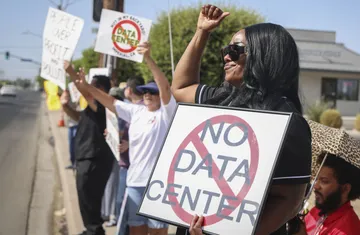
对服务器农场热潮的政治反对正在增长,而建设延误、设备故障和电力限制正在损害开发商并拖慢项目进度。最新的担忧是,人工智能工具和服务的预计收入远远低于为这些庞大计算设施投资所需的回报。对于较小的基础设施提供商来说,这可能是致命的。
Political opposition to the boom in server farms is growing, while construction delays, equipment failures and power constraints are hurting developers and slowing down projects. The latest concern is that projections for likely revenues from AI tools and services are coming up far short of what’s needed to deliver any return on investments in the vast computer facilities. For smaller infrastructure providers, that could prove deadly.
像英国的Nscale这样的所谓“新云”公司正感受到压力。例如,微软公司决定退出与该公司在伦敦附近的一个数据中心项目,给Nscale计划在美国股市上市蒙上了阴影。包括领先的人工智能模型制造商OpenAI在内的几项其他计划中的首次公开募股已被搁置。与此同时,另一家新云公司CoreWeave Inc.的公开股票和债券遭到重挫,费城半导体指数在上周末连续八天下跌,创下2008年以来的最长跌幅。
So-called neocloud companies such as Britain’s Nscale are feeling the pressure. Microsoft Corp.’s decision to pull out of a data-center project near London with the firm, for example, has cast doubts on Nscale’s planned US stock-market listing. Several other planned initial public offerings, including one for leading AI model-maker OpenAI, have been put on ice. Meanwhile, the public shares and bonds of another neocloud, CoreWeave Inc., have been hammered, and the Philadelphia Semiconductor Index had an eight-day losing streak through the end of last week, its longest since 2008.
从Nscale这样的新兴公司到Alphabet Inc.这样的巨头,这场基础设施热潮中的所有参与者都在追逐同一个想法:谁能让最多的芯片运转起来,谁就能锁定最大的合同并赢得人工智能计算竞赛。“我们正处于一个必须做大的时期,”CoreWeave联合创始人布兰宁·麦克比在接受《金融时报》采访时说道,这番采访充满了泡沫般的狂妄。
All of the players in this infrastructure boom, from upstarts such as Nscale to giants including Alphabet Inc., are chasing the idea that whoever gets the most chips humming can lock in the biggest contracts and win the AI computing race. “We are in a period where you have to be huge,” CoreWeave co-founder Brannin McBee told the Financial Times in an interview full of bubble-blowing hubris.
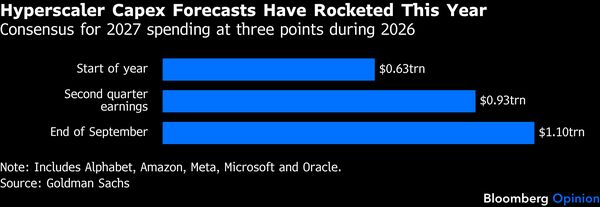
这种思维方式推动了资本支出计划的惊人升级。今年年初,分析师估计,仅五家超大规模云服务提供商 — — Alphabet、亚马逊公司、Meta Platforms公司、微软公司和甲骨文公司 — — 将在2027年在新数据中心上花费6300亿美元。如今这一预测几乎翻了一倍,达到1.1万亿美元。
This mindset has driven the dizzying escalation of capital spending plans. At the start of this year, analysts estimated that the five hyperscalers alone — Alphabet, Amazon Inc., Meta Platforms Inc., Microsoft and Oracle Corp. — would spend $630 billion on new data centers in 2027. That forecast has now almost doubled to $1.1 trillion.
这就是为什么人们开始更仔细地审视这些投入可能产生的收入。贝恩公司的顾问在9月下旬预测,到2031年,消费者和企业在AI上的支出可能产生的收入可能低于2万亿美元,远低于为证明计划投资合理所需的6万亿美元。
That’s why people have started to look more closely at the income all this outlay could generate. Consultants at Bain & Co. predicted in late September that the likely revenue available from AI spending by consumers and companies by 2031 would be less than $2 trillion, which is far below the $6 trillion needed to justify planned investments.
上周,Gartner公司进一步加码,该科技研究公司估计,到2032年,数据中心所有者将面临与基础设施支出相比高达6万亿美元的收入缺口 — — 并且近4万亿美元存在被计入超出全球AI需求的多余部分而被冲销的风险。“按照预测趋势,大规模AI资本资产减记的可能性更大,”Gartner分析师Will Sommer写道。
Last week, Gartner Inc. upped the ante when the tech research firm estimated that data center owners would face a revenue shortfall of $6 trillion by 2032 compared with infrastructure spending — and that nearly $4 trillion risks getting written off as excess to the world’s AI needs. “At forecast trends, massive AI capital asset write-downs are more likely than not,” Gartner analyst Will Sommer wrote.
尽管对该行业创造收入能力的不确定性仍然存在,华尔街银行高管们在最近的第三季度财报电话会议上仍对即将进行的融资 — — 以及由此产生的费用 — — 持乐观态度。“没有人知道,随着更广泛的AI生态系统成熟,资本和算力的需求将如何演变,”高盛集团首席执行官David Solomon如此表示。
Wall Street banking executives were still bullish on the financing to be done — and fees to be made — from the AI boom on their recent third-quarter earnings calls, in spite of the uncertainty about the sector’s ability to generate revenue. “No one knows how the demands for capital and compute will evolve as the broader AI ecosystem matures,” as Goldman Sachs Group Inc. Chief Executive Officer David Solomon put it.
但即使是高盛自身的美国股票分析师也持怀疑态度。股票分析师瑞安·哈蒙德最近写道,五家超大规模云服务提供商以及Space X公司需要在2026年和2027年每年额外创造3000亿美元的人工智能服务收入,才能在资本支出上实现收支平衡;若要获得10%的回报率,则需要超过4000亿美元。截至今年第二季度,他们从云服务中获得的、高于人工智能之前趋势的额外收入仅为年化700亿美元 — — 而预测的短期增长也无法弥补这一差距。
But even Goldman’s own US equity analysts have doubts. The five hyperscalers plus Space X Inc. need to generate an extra $300 billion annually in AI services revenue in 2026 and 2027 just to break even on their capital spending, stock analyst Ryan Hammond wrote recently. They need to deliver more than $400 billion to make a 10% return. As of the second quarter of this year, the extra cloud-services income they’re getting above pre-AI trends was just $70 billion annualized — and predicted near-term growth doesn’t close the gap.
云服务提供商也有一线希望:他们应从即将启动的新数据中心所对应的合同中获得的收入积压。据彭博情报报道,仅Alphabet、亚马逊和微软三家公司报告的所谓“剩余履约义务”在6月底已达1.7万亿美元。这一数字的增长速度几乎与其支出计划相当,从一年前不到7000亿美元跃升至目前水平。当这些超大规模云服务提供商本月下旬公布第三季度业绩时,这些数字很可能会再次增长。
There is a potential silver lining for the cloud providers: the backlog of revenue they should get from contracts due to start once new data centers come online. The so-called Remaining Performance Obligations reported by Alphabet, Amazon and Microsoft alone totaled $1.7 trillion at the end of June, according to Bloomberg Intelligence. They have grown almost as rapidly as spending plans, jumping from less than $700 billion a year before. When the hyperscalers report third-quarter results later this month, those numbers will likely have grown again.
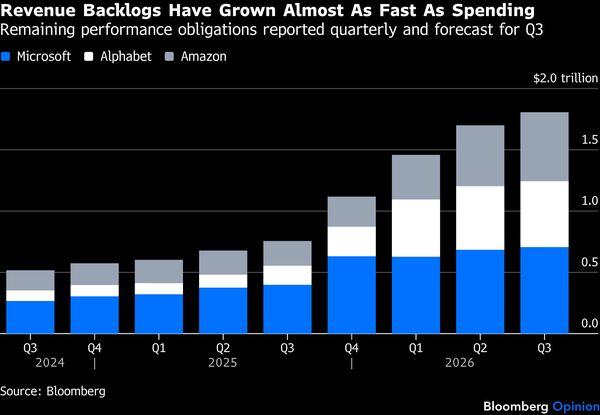
然而,关于剩余履约义务,也有几个原因需要保持谨慎。这些义务并不保证一定会实现,且有些可以被重新谈判。许多义务要数年后才能开始实现,且可能高度依赖单一客户。例如,据彭博情报报道,微软6840亿美元的收入积压中,近一半来自OpenAI的单独合同;亚马逊4960亿美元的积压中,有五分之一来自Anthropic PBC。
There are several reasons to be cautious about RPOs. They aren’t guaranteed, and some can be renegotiated. Many aren’t due to start for several years and they can be highly dependent on a single client. For example, almost half of Microsoft’s $684 billion revenue backlog is contracted from OpenAI alone, according to Bloomberg Intelligence; one-fifth of Amazon’s $496 billion is due from Anthropic PBC.
AI软件公司自身也对行业收入前景产生了怀疑。Anthropic上周在计划于11月进行IPO之前向投资者发布的更新显示,季度销售增长从今年早些时候的140%放缓至50%。OpenAI本月通过向投资者提供远低于此前更新的新收入指引(尽管计量方式不同)震惊了市场。更糟的是,根据《The Information》的报道,Meta和微软都已要求各自员工减少使用Anthropic的领先模型Claude。整个AI项目充斥着内部风险。
The AI software firms themselves have also aroused skepticism over the outlook for industry income. Anthropic’s update to investors last week ahead of its planned November IPO showed a slowdown in quarterly sales growth to 50% from 140% earlier this year. OpenAI rocked markets this month by giving investors new revenue guidance that was far below earlier updates (albeit measured differently). To top it all, Meta and Microsoft have both told their own staff to cut back on use of Anthropic’s leading model, Claude, according to The Information. The whole AI project is rife with internecine risks.
正如Gartner的Sommer所指出的,资本涌入这一繁荣已催生出一场争夺市场份额的生死竞争。投资者和贷款方如今应认识到站在失败一方可能带来的后果。
The flood of capital into this boom has given birth to an existential competition for market share, as Gartner’s Sommer put it. It’s high time that investors and lenders recognize the possible consequences of ending up on the losing side.