中国国家队可能需要加快股票购买步伐,因为基准指数刚刚创下连续下跌的纪录,尽管仅靠国家支持的买入可能不足以让市场实现持续复苏,彭博情报(Bloomberg Intelligence)指出。
China’s national team may need to accelerate stock purchases after the benchmark notched a record losing streak, though state-backed buying alone may not be enough to put the market on a sustained recovery, according to Bloomberg Intelligence.
作为领导中国市场稳定工作的国家支持投资者,中央汇金投资有限责任公司上半年通过ETF销售筹集了2310亿美元,但自7月恢复购买以来仅重新部署了430亿美元,彭博情报分析师包括Rebecca Sin在报告中写道。这留下了约1880亿美元的“干粉”,按最近的购买速度足以支撑75个交易日的买入。
Central Huijin Investment Co., the state-backed investor that leads China’s market stabilization efforts, raised $231 billion through ETF sales in the first half but has redeployed just $43 billion since purchases resumed in July, BI analysts including Rebecca Sin wrote in a note. That leaves about $188 billion in dry powder, enough for 75 sessions of buying at the recent pace.
分析师称:“在无法指望全球股市反弹的情况下,国家队可能需要买入更多、持续时间更长,这与其最近两次救市行动——2025年4月的关税冲击和2026年7月的科技股抛售——形成对比。限制因素不是能力,而是部署资金的意愿。到目前为止,本月的买入节奏表明国家队持谨慎态度。”
“With no global equities rebound to rely on, the national team might need to buy more and do so for longer than in its two most recent rescues, during the April 2025 tariff shock and the July 2026 technology selloff,” according to the analysts. “Capacity isn’t the constraint; willingness to deploy money is. So far this month, the pace of buying suggests the national team is cautious,” they added.
根据彭博情报估算,国家支持的资金在10月9日至20日期间花费约150亿美元。这一节奏慢于2026年7月的救市行动。
According to BI estimates, state-backed funds spend about $15 billion between Oct. 9 through Oct. 20. That pace was slower than the July 2026 rescue.
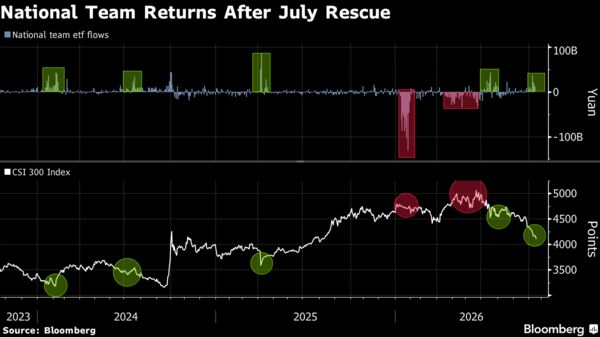
随着沪深300指数在经历10周抛售后逼近技术性熊市,本月国家队买入的迹象有所增加。近期抛售不成比例地集中在科技板块,科创50指数较高点下跌近40%,在全球AI股抛售中成为该地区表现最差的指数之一。
Signs of national-team buying have picked up this month as the CSI 300 Index nears a technical bear market following 10 weeks of selling. The recent selling has been disproportionately centered on tech, with the Star50 Index down nearly 40% from its peak amid the global AI rout, making it one of the region’s worst performers.
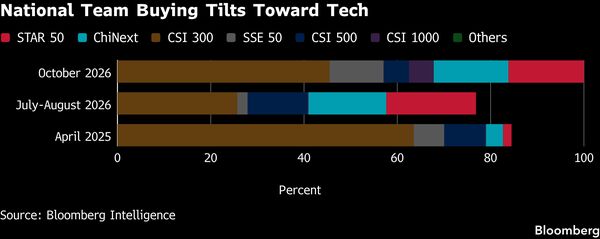
彭博情报指出,国家支持买入的构成已转向科技和成长股。10月迄今,沪深300指数在购买中的估计占比约为45%,低于历史上的55%。与此同时,科技股占比较高的科创50和创业板指数合计占比升至约32%,高于历史上的11%。这与北京推动发展自主技术、维护股市作为融资来源的方向一致。
The composition of state-backed buying has shifted toward technology and growth shares, BI notes. In October so far, the CSI 300’s estimated share of purchases has been about 45% so far, down from 55% historically. Meanwhile, the combined share of the tech-heavy Star50 and ChiNext gauges rose to about 32% from 11% historically. That dovetails with Beijing’s push to develop homegrown technology and preserve the stock market as a source of capital.
挑战不仅在于资金投向何处。BI 指出,由恐慌驱动的抛售一旦抛压耗尽便有可能遏制,而由国内投资者情绪疲软推动的持续下跌则更难扭转。这意味着需要“比以往市场救援更多的资金和政策支持”。
The challenge goes beyond where the money is being deployed. BI says that a panic-driven selloff can potentially be stemmed once selling is exhausted, while a steady decline fueled by weak domestic investor sentiment is harder to reverse. That would mean “more capital and policy support than market rescues” of the past.
2024 年曾出现类似挑战,当时持续的 ETF 买入在夏季托住了股市,但未能带来持久的反转,直到 9 月更广泛的政策措施提振了情绪。
A similar challenge emerged in 2024, when sustained ETF buying cushioned stocks through the summer, but failed to deliver a lasting turnaround until broader policy measures lifted sentiment in September.
不过,据北京渐近线投资研究负责人朱振新表示,“国家队”回归更多是为了减缓抛售,而非制造反转,走势最终仍由基本面决定。
Still, the national team’s return is more about slowing the selloff than engineering a turnaround, with direction ultimately determined by fundamentals, according to Zhu Zhenxin, head of Asymptote Investment Research in Beijing.
他说:“如果市场下跌过快,国家队大概率会继续买入,尽管干预可能不足以扭转市场。如果跌势放缓或市场横盘,买入大概率会停止。”
“If the market falls too quickly, the national team will probably continue buying, though the intervention may not be enough to reverse the market,” he said. “If the decline slows or the market moves sideways, the buying will probably stop.”