10月27日,以色列将举行第26届以色列议会的选举,这是自加沙地带针对巴勒斯坦人的种族灭绝行为以及针对黎巴嫩和伊朗的战争以来首次举行的全国性大选。
on October 27 to elect the 26th Knesset, in the first general vote since the genocide against Palestinians in Gaza and the wars on Lebanon and Iran.
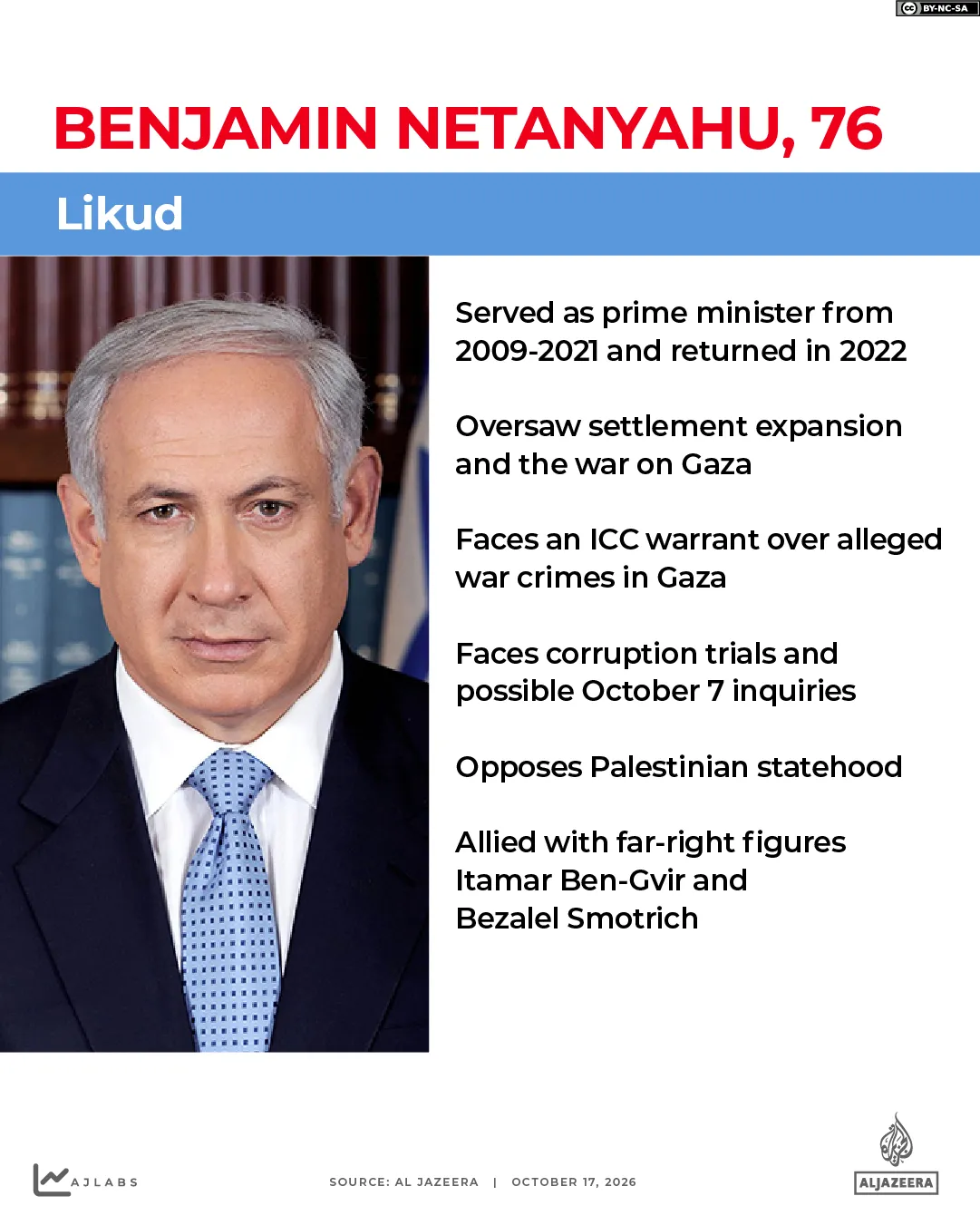
本雅明·内塔尼亚胡是以色列历史上在任时间最长的总理(共执政19年),他正在面临腐败指控的审判,同时仍试图连任。他所领导的利库德党及其极右翼联盟与由犹太人主导的反对派阵营展开了激烈的竞争;目前看来,没有任何一方能够单独获得以色列议会120个席位中的绝对多数。
Benjamin Netanyahu, the longest-serving prime minister in Israel’s history, with 19 years in office, is seeking another term while standing trial on corruption charges. His Likud party and the far-right coalition it leads are locked in a close race with a Jewish-led opposition bloc, with neither side appearing on track to win an outright majority in the 120-seat Knesset, Israel’s parliament.
根据以色列中央选举委员会的数据,约有730万18岁及以上的公民具有投票资格。大多数投票站的开放时间为上午7点至晚上10点;如果在投票站关闭时仍有选民排队,他们仍有权投票。选举当天是法定假日。
About 7.3 million people aged 18 and above are eligible to vote, according to Israel’s Central Elections Committee. Most polling stations open from 7am to 10pm, and anyone still queuing when they close is entitled to vote. Election day is a national holiday.
任何获得3.25%以上选票的政党都将进入议会,其任期为四年。不过,总理职位没有任期限制。
Any party clearing an electoral threshold of 3.25 percent enters parliament, which sits for a four-year term. There are no term limits for a prime minister.
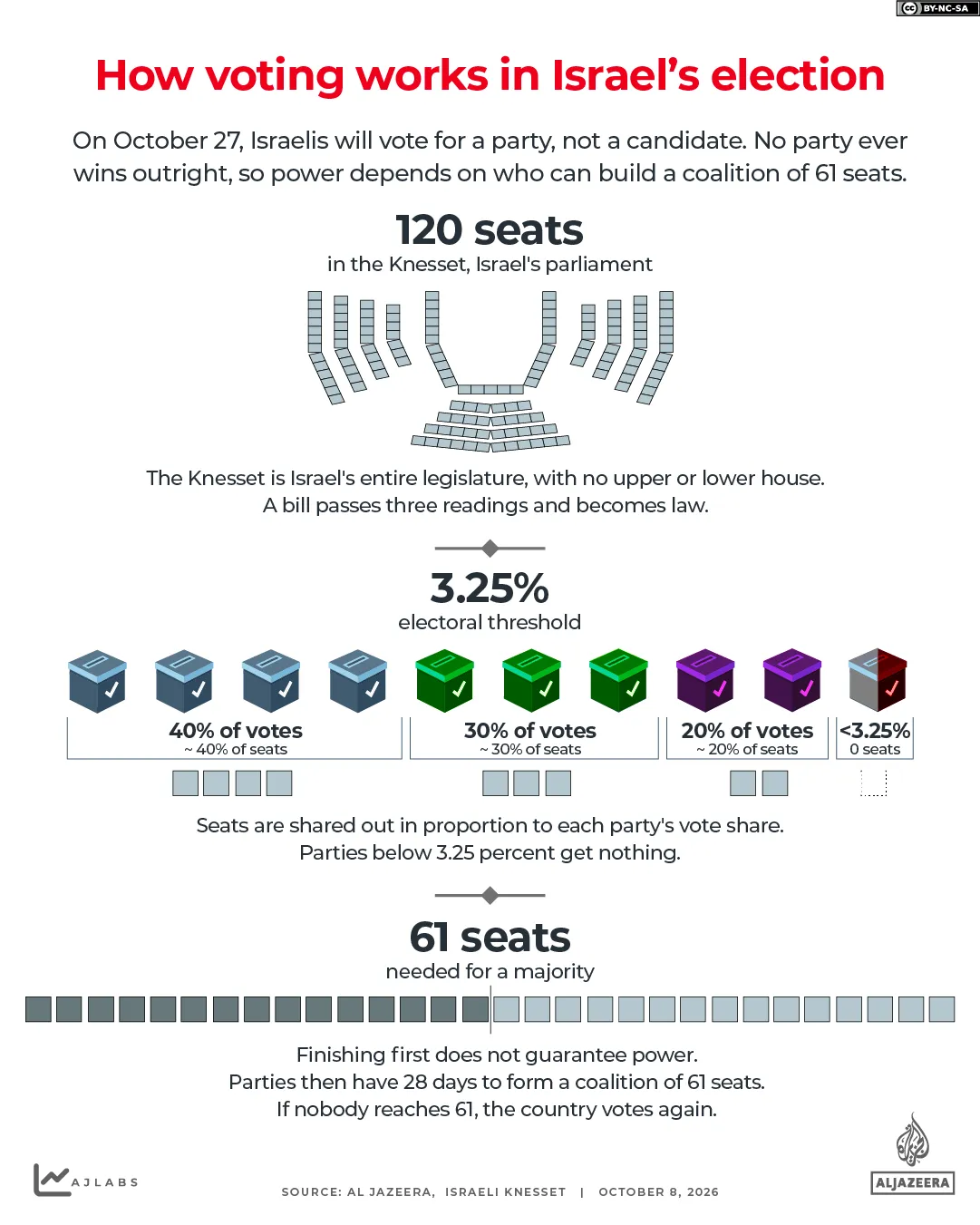
投票方式:以色列公民投票的是政党,而非具体的候选人。
How voting works Israelis vote for a party, not a candidate.
获胜条件:要赢得议会控制权,需要获得120个席位中的61个席位——但迄今为止还没有任何政党能够实现这一目标。即使某个政党在选举中得票最多,也不能确保执政权。获胜政党有28天的时间(最长可延长至32天)来组建能够获得61个席位的联盟;如果无法成功组建联盟,以色列将重新举行选举。
A majority requires 61 of the 120 seats and no party has ever won that outright. Finishing first does not guarantee power. Parties then have 28 days, with a possible extension of up to 14 days, to assemble a coalition reaching 61. If nobody manages it, the country votes again.
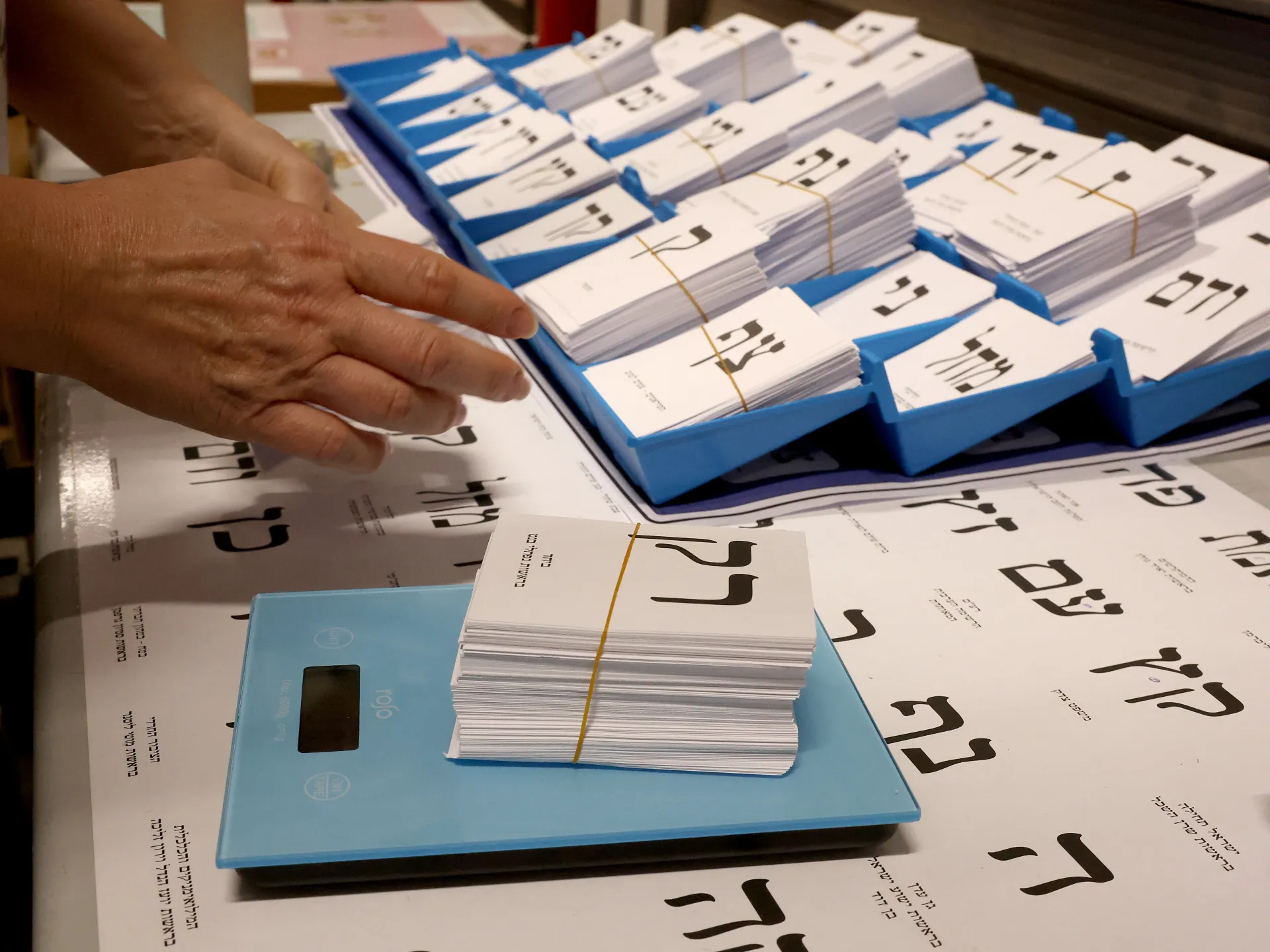
席位分配机制:议会的席位根据各政党在全国选举中的得票比例进行分配:例如,获得30%选票的政党大约会获得30%的席位。那些得票率低于3.25%的政党将失去所有席位;这也解释了为什么小政党通常会在每次选举前选择合并。
Seats are shared out in proportion to each party’s share of the national vote, so a party winning 30 percent of votes takes roughly 30 percent of seats. The votes for parties failing to secure 3.25 percent are discarded, which explains why small parties routinely merge before every election.
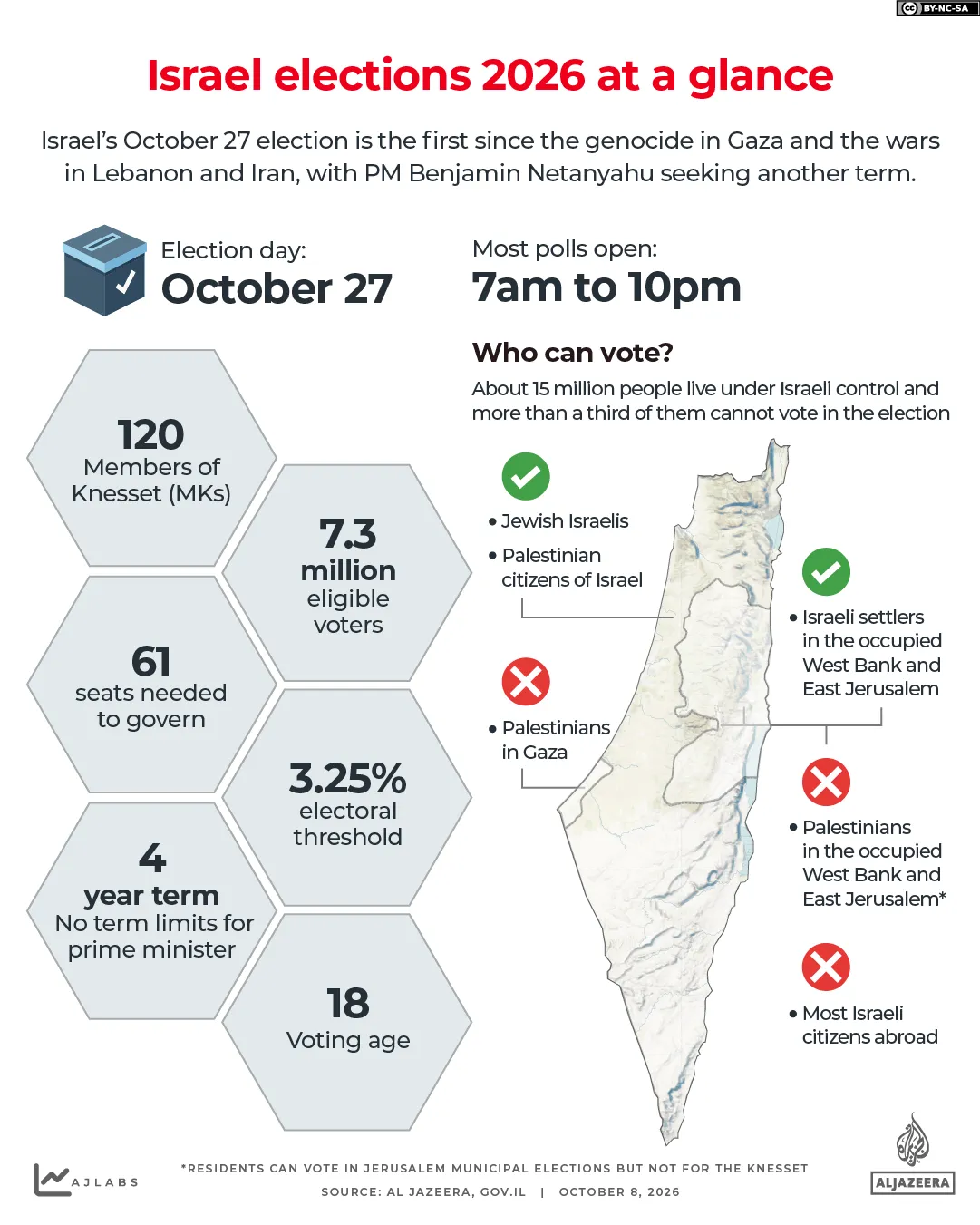
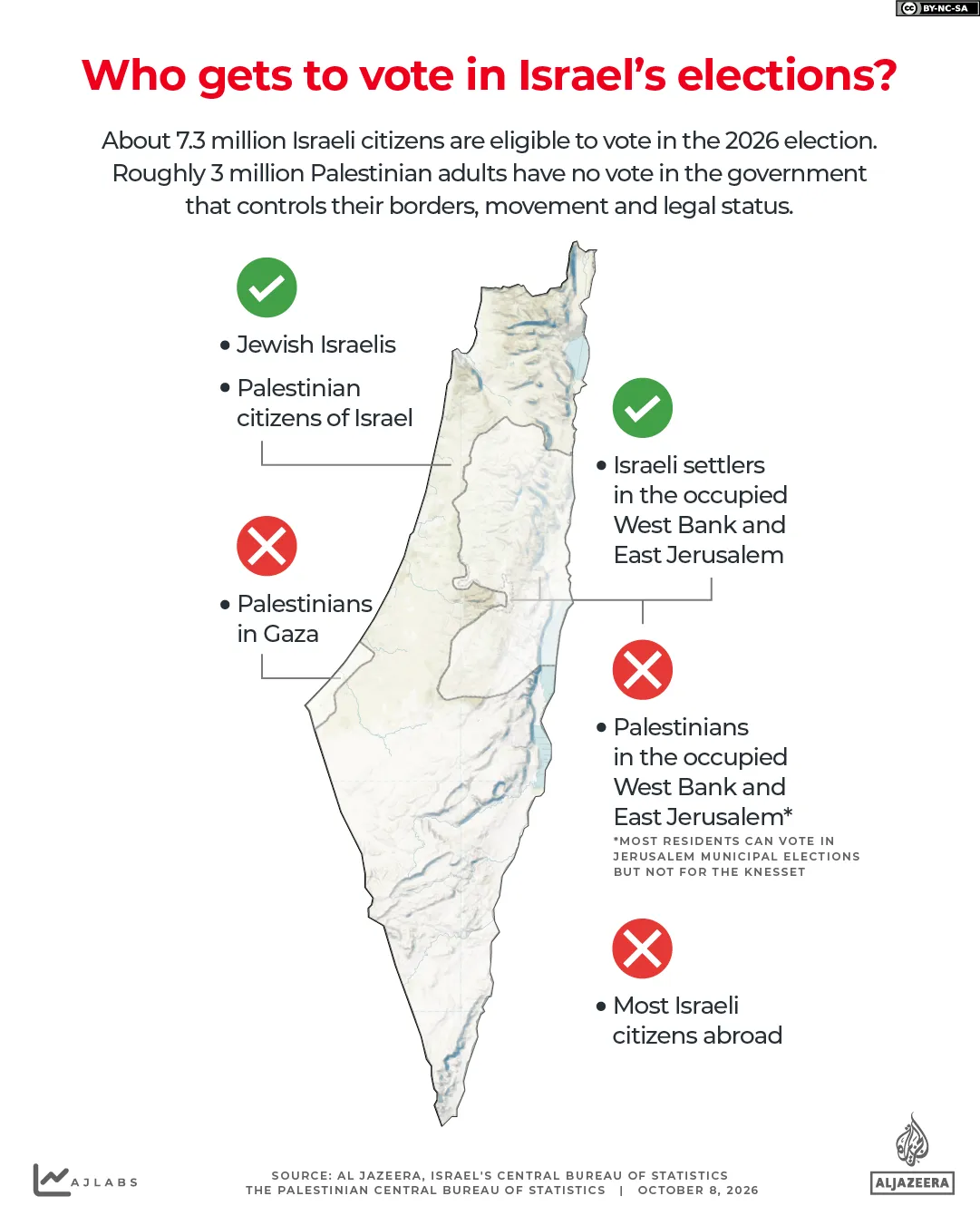
谁有投票权,谁没有投票权?:大约730万以色列公民具有投票资格,但他们并非唯一生活在自己所选政府统治下的成年人。实际上,在加沙地带、被占领的西岸地区以及被占领的东耶路撒冷地区,约有300万巴勒斯坦成年人没有投票权;这些地区的政治、迁徙和法律地位都由控制这些地区的以色列政府决定。
Who can and cannot vote? About 7.3 million Israeli citizens are eligible to vote in this election, but they are not the only adults living under the government they choose. Roughly three million adult Palestinians in Gaza, the occupied West Bank and occupied East Jerusalem have no vote in the government that controls their borders, movement and legal status.
在以色列,约120万的犹太裔以色列人和巴勒斯坦公民拥有投票权。同样,居住在被占领的西岸和东耶路撒冷的75万多名以色列定居者也拥有投票权;这些定居者参与选举,从而决定了管理他们所居住地区的议会。
Jewish Israelis and Palestinian citizens of Israel, who number about 1.2 million, can vote. So can adult settlers among the more than 750,000 Israelis living in the occupied West Bank and occupied East Jerusalem, who help elect the parliament that legislates over the land they live on.
在被占领的东耶路撒冷,大多数巴勒斯坦人虽然持有以色列的居住许可,但并不拥有公民身份。他们可以投票选举耶路撒冷市议会成员,却无权投票选举以色列议会(Knesset)的成员。
Most Palestinians in occupied East Jerusalem hold Israeli residency, not citizenship. They can vote for Jerusalem’s city council but not for the Knesset.
这种状况在被占领的西岸形成了明显的矛盾:定居者可以投票,而生活在同一军事管辖区域内的巴勒斯坦家庭却无法投票。
The result is a sharp anomaly in the occupied West Bank, where a settler votes and a Palestinian family living nearby, under the same military authority, does not.
大多数居住在海外的以色列公民也没有投票权,因为以色列不允许通过邮寄方式投票,要求选民必须在选举当天亲自回到国内投票。外交官和国家代表是例外,他们可以在10月20日在以色列驻外机构投票。这次选举中,以色列面临一系列国内和国际问题,主要包括:
Most Israeli citizens living abroad also cannot vote, because Israel has no general absentee ballot and requires voters to be physically in the country on election day. Diplomats and state emissaries are the exception, casting their ballots at Israeli missions on October 20. What are the main issues?
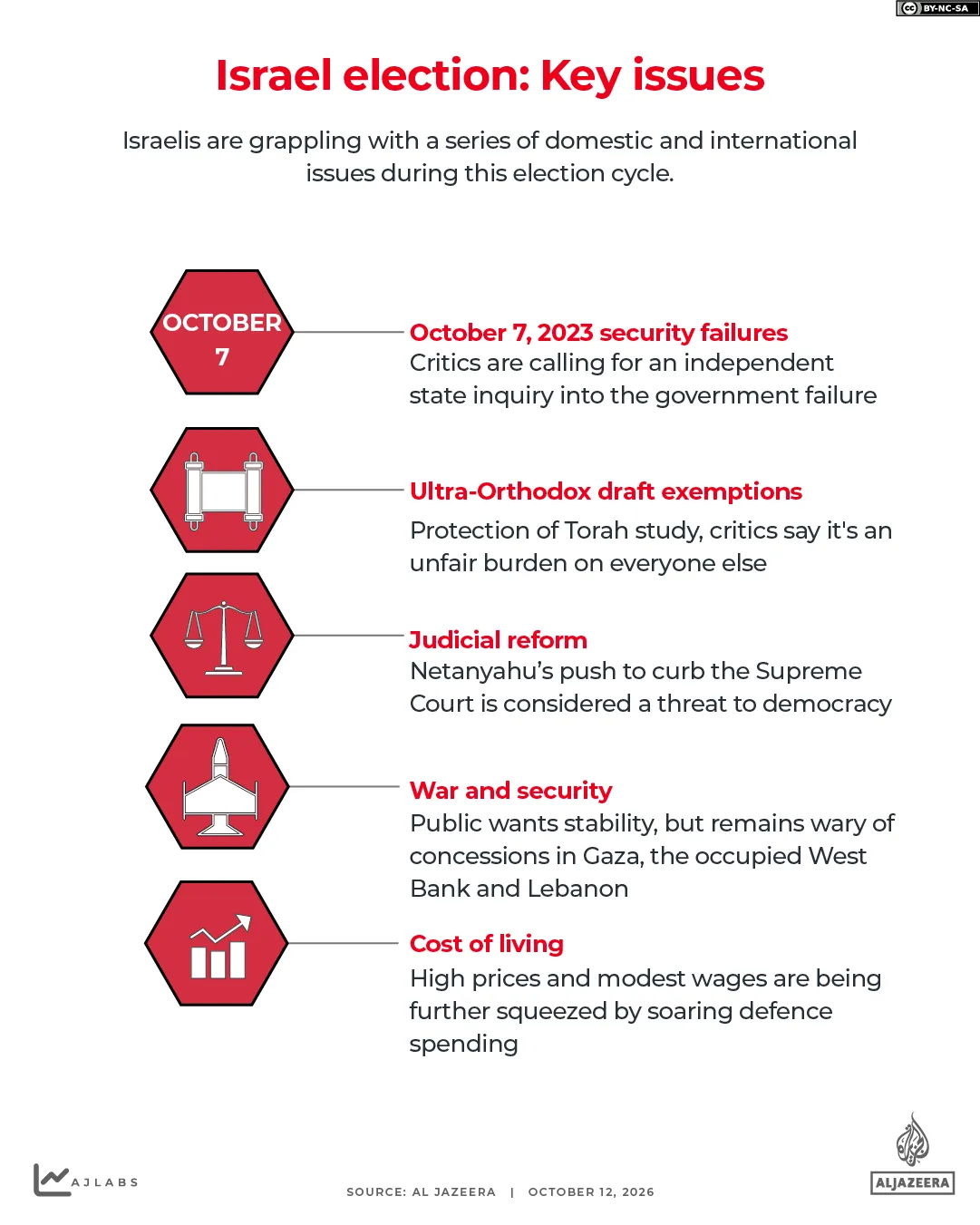
10月7日的安全事件:三年过去了,政府仍未成立专门调查委员会来调查2023年10月7日的事件。那次由哈马斯发动的袭击导致约1200人死亡、250人被俘。以色列随后对巴勒斯坦人发动了大规模军事行动,造成至少7.4万人死亡,大部分被围困地区沦为废墟。
Israelis are dealing with a series of domestic and international issues this election cycle, including: October 7 security failures– Three years on, the government is yet to form a state commission of inquiry into the events of October 7, 2023, when a Hamas-headed attack led to the killing of some 1,200 people, with about 250 taken captive.
关于免除服兵役的法律规定:支持这项规定的人士认为这有助于人们专心从事《托拉》(犹太教经典)的学习,但批评者指出这给其他公民带来了不公平的军事负担。
Israel launched the genocidal war against Palestinians in the wake of the attack, killing at least 74,000 people and leaving most of the besieged territory in ruins.
司法改革:内塔尼亚胡试图限制以色列最高法院的权力,这一举措在加沙战争前引发了大规模抗议。批评者认为这威胁到了民主制度,而支持者则认为最高法院已经越权了。总之,这次以色列选举反映了该国复杂的国内政治与外交局势。
Ultra-Orthodox draft exemptions– Supporters of the exemptions say they protect full-time Torah study, but critics argue they place an unfair military burden on everyone else. Judicial reform– Netanyahu’s push to curb the Supreme Court’s powers, which sparked mass protests before the war on Gaza, remains a deep fault line. Critics see it as a threat to democracy, while supporters argue that the court has overstepped its authority.
战争与安全– 公众渴望稳定,但在加沙、被占领的西岸和黎巴嫩问题上仍对让步持警惕态度。内塔尼亚胡承诺“全面胜利”,但哈马斯和真主党仍保持作战能力。
War and security– The public wants stability but remains wary of concessions in Gaza, the occupied West Bank and Lebanon. Netanyahu promised “total victory”, but Hamas and Hezbollah remain operational.
生活成本 高物价和微薄的工资正因国防开支激增而进一步被挤压。自2023年以来,以色列的国防预算已翻倍,增加了对公共财政的压力。
Cost of living High prices and modest wages are being further squeezed by soaring defence spending. Since 2023, Israel’s defence budget has doubled, increasing pressure on public finances.
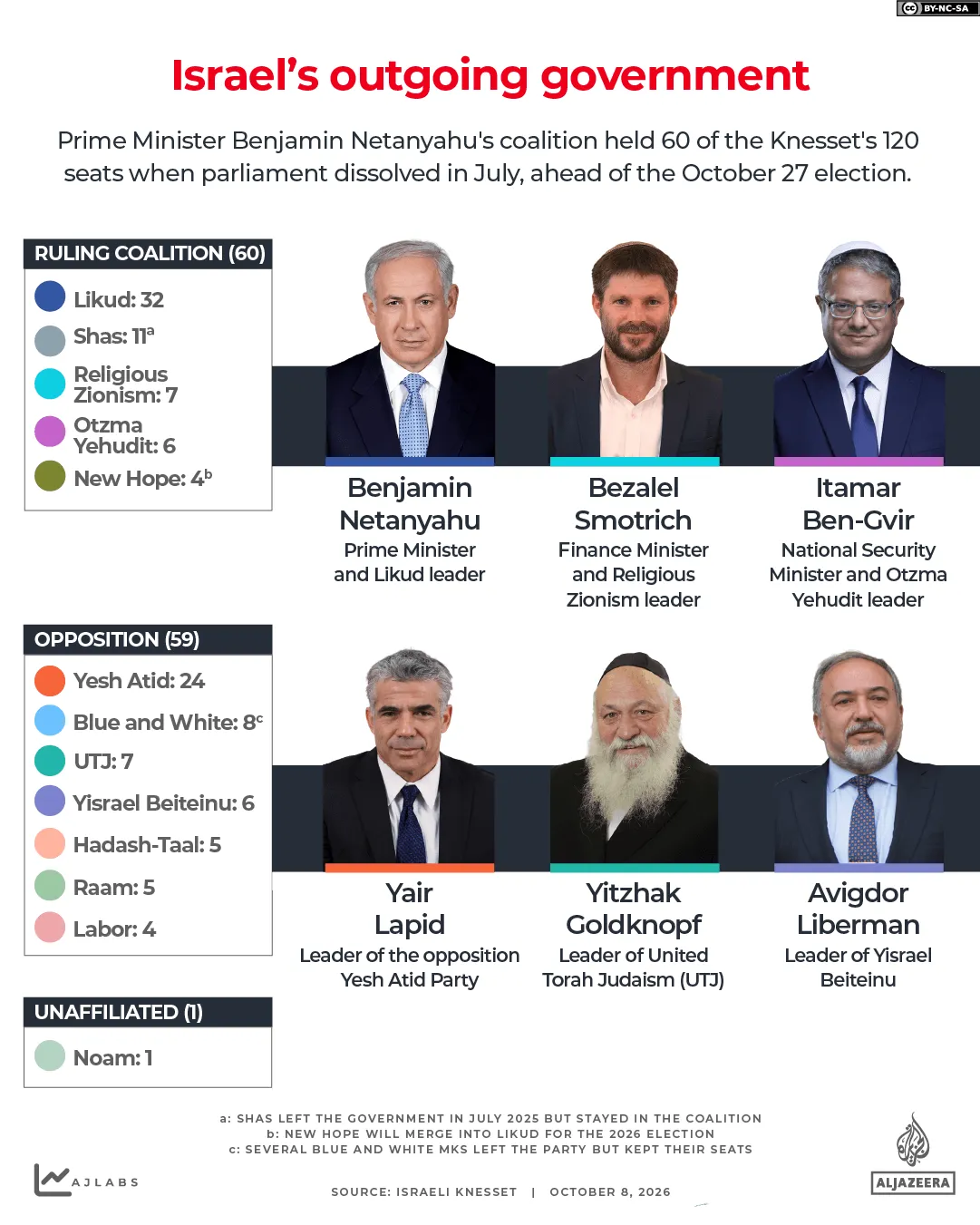
以色列的看守政府 内塔尼亚胡的联盟在议会于7月解散时,控制了议会120席中的60席。该联盟由拥有32席的利库德党、11席的沙斯党、7席的宗教锡安主义党、伊塔马尔·本-格维尔领导的犹太力量党(6席)以及4席的新希望党组成。沙斯党于2025年7月退出政府,但仍留在联盟中;新希望党将在本次选举中并入利库德党。
Israel’s outgoing government Netanyahu’s coalition held 60 of the Knesset’s 120 seats when parliament dissolved in July. It comprised Likud with 32 seats, Shas with 11, Religious Zionism with seven, Itamar Ben-Gvir’s Otzma Yehudit with six, and New Hope with four. Shas left the government in July 2025 but remained in the coalition and New Hope will merge into Likud for this election.
反对派控制59席:有24席的耶希阿蒂德党、8席的蓝白党、7席的联合托拉犹太党、6席的以色列贝特努党、哈达什-塔阿尔党和拉阿姆党各5席,以及4席的工党。诺阿姆党的1席无党籍。谁是主要竞争者?内塔尼亚胡正寻求连任,但正面临腐败指控的审判,他予以否认。
The opposition held 59 seats: Yesh Atid with 24, Blue and White with eight, United Torah Judaism with seven, Yisrael Beiteinu with six, Hadash-Taal and Raam with five each and Labor with four. Noam’s single seat was unaffiliated. Who are the main contenders? Netanyahu is seeking re-election while facing a trial on corruption charges, which he denies.
他的极右翼联盟正面对由四个主要犹太领导的反对派政党组成的联盟,这些政党的领导人已签署一项宣言,承诺在选举前不互相攻击,并在选举后联手组建政府。
His far-right coalition is up against a bloc comprising of four major Jewish-led opposition parties, whose leaders have signed a declaration promising not to attack each other ahead of the vote and to join forces in forming a government after the polls.
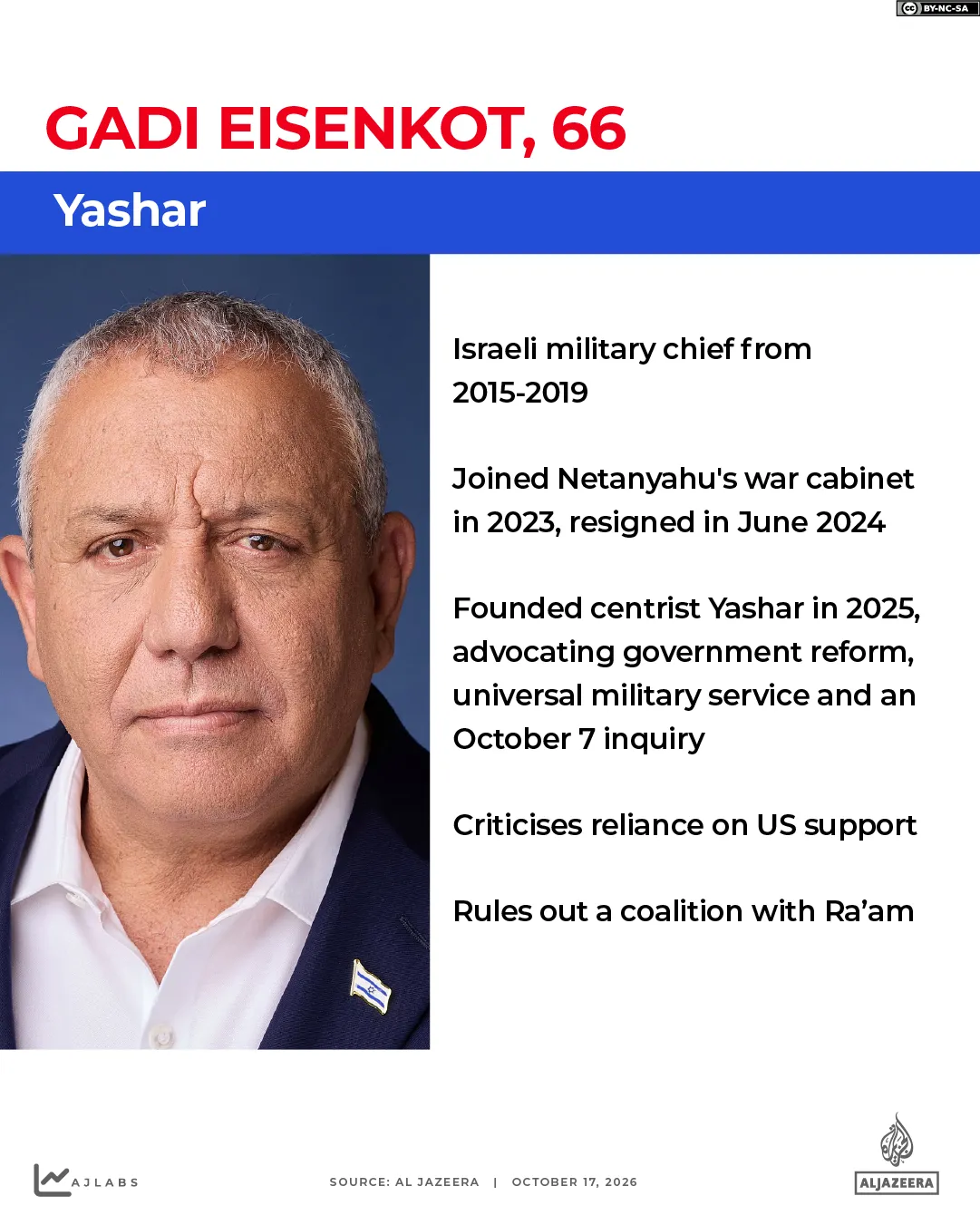
前陆军参谋长加迪·艾森科特被视为反对派最有可能成为总理的候选人,他的新政党“正直党”(Yashar)在民意调查中与利库德党势均力敌。
Former army chief Gadi Eisenkot is viewed as the opposition’s most likely candidate for prime minister, with his new Yashar party evenly matched with Likud in the opinion polls.
反对派联盟包括由前总理纳夫塔利·贝内特和雅伊尔·拉皮德领导的“共同名单”;阿维格多·利伯曼领导的以色列贝特努党;以及雅伊尔·戈兰领导的民主党。
The opposition alliance includes the Together list, led by former Prime Ministers Naftali Bennett and Yair Lapid; Avigdor Liberman’s Yisrael Beiteinu and Yair Golan’s Democrats.
其他关键人物还包括极右翼部长伊塔马尔·本-格维尔和贝扎莱尔·斯莫特里希;正统派犹太教党派;以及以阿拉伯人为多数的拉阿姆党和联合名单。
Other key players include far-right ministers Itamar Ben-Gvir and Bezalel Smotrich, the ultra-Orthodox parties, and the Arab-majority lists Ra’am and the Joint List.
上个月,以色列中央选举委员会投票决定禁止“拉阿姆党”及“联合名单联盟”参与选举。不过,最高法院于10月2日一致推翻了这一禁令,裁定相关证据并未达到剥夺参选资格的法律标准。
Last month, Israel’s Central Elections Committee voted to bar Ra’am and the Joint List from the election, but the Supreme Court unanimously overturned the bans on October 2, ruling that the evidence did not meet the legal threshold for exclusion.
萨米·阿布·谢哈德是一名拥有以色列国籍的巴勒斯坦人,也是“联合名单联盟”成员党“巴拉德党”的领导人。在法院释放出多数法官将支持取消其参选资格的信号后,他选择退出竞选。
Sami Abu Shehadeh, a Palestinian citizen of Israel who leads Balad, one of the parties in the Joint List, withdrew from the race after the court signalled that a majority of its judges would uphold his disqualification.
此次选举结束后,由阿拉伯政党组成的联盟或许能掌握关键话语权,但大多数犹太裔反对派政党的领导人均明确表示不会与这些政党联手。
The Arab-led parties could hold the balance of power after the vote, but most leaders of the Jewish-led opposition bloc have ruled out joining forces with them.
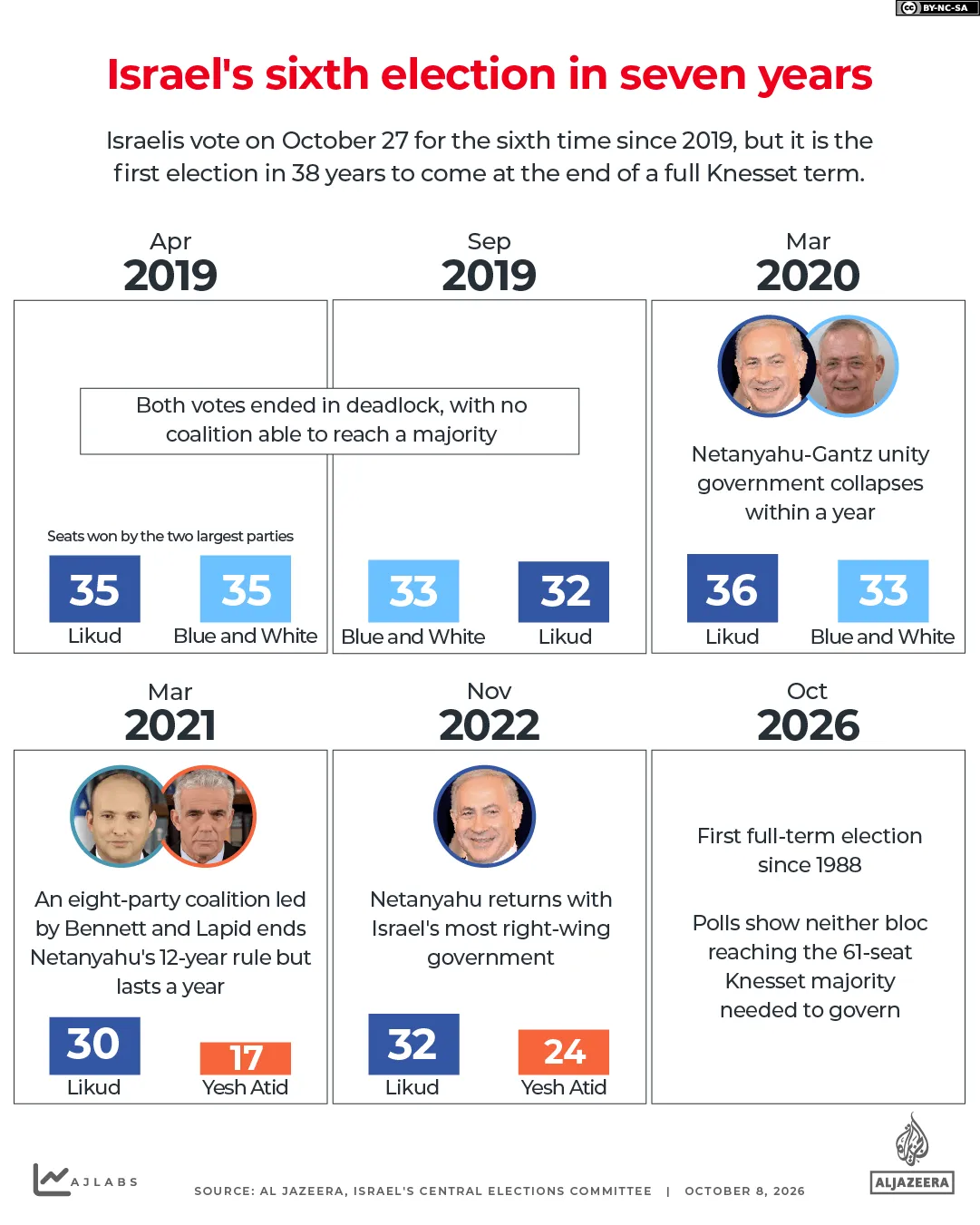
七年内的第六次选举:10月27日举行的选举将是以色列自2019年以来举行的第六次全国大选,也是38年来首次在议会正常任期届满时举行的选举。
Sixth election in seven years October 27 will be Israel’s sixth national vote since 2019, but the first in 38 years to arrive at the natural end of a full Knesset term.
以色列的政治动荡始于2019年4月:当时内塔尼亚胡领导的利库德集团与本尼·甘茨领导的“蓝白党”均获得35个议席,得票数持平。同年9月举行的第二次选举依然未能打破僵局:“蓝白党”获得33席,利库德集团获得32席,两轮选举均未能组建出能获得多数支持的联合政府。
The instability began in April 2019, when Netanyahu’s Likud party and Benny Gantz’s Blue and White party tied on 35 seats each. A second vote that September produced another deadlock, with Blue and White on 33 and Likud on 32, and neither round yielded a coalition able to reach a majority.
2020年3月的第三次选举中,利库德集团获得36席,略高于“蓝白党”的33席。双方随后组建了内塔尼亚胡与甘茨共同领导的联合政府,但该政府仅维持了一年便宣告解体。2021年3月,利库德集团获得30席,而“未来党”获得17席;由纳夫塔利·贝内特与亚伊尔·拉皮德牵头、还包括阿拉伯政党“拉阿姆党”在内的八党联合政府终结了内塔尼亚胡长达12年的执政生涯,该政府也仅维持了一年。
A third election in March 2020 gave Likud 36 seats to Blue and White’s 33, and produced a Netanyahu-Gantz unity government that collapsed within a year. In March 2021, Likud won 30 seats to Yesh Atid’s 17, but an eight-party coalition led by Naftali Bennett and Yair Lapid that also included Ra’am, an Arab party, ended Netanyahu’s 12-year run. It lasted a year.
2022年11月,内塔尼亚胡再度掌权:当时利库德集团获得32席,“未来党”获得24席,他领导的政府被外界称为以色列历史上最右翼的政府。目前的民调显示,两大阵营均难以单独获得61个议席的多数优势。
Netanyahu returned in November 2022, with Likud on 32 and Yesh Atid on 24, at the head of what has been described as Israel’s most right-wing government. Polls now show neither bloc clearly reaching 61.
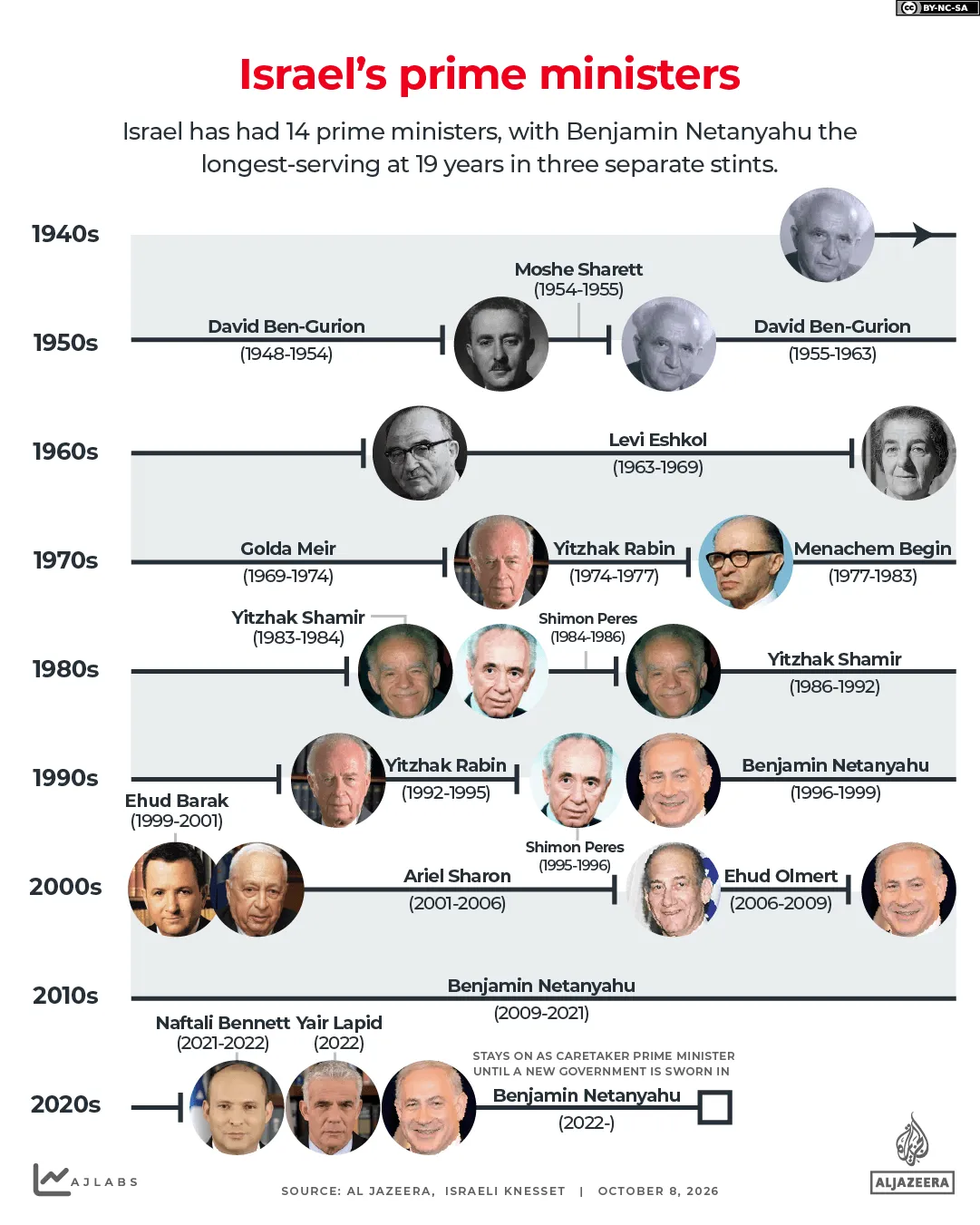
以色列的总理:自1948年建国以来,以色列共诞生过14位总理。内塔尼亚胡的执政时长遥遥领先,他先后三次担任总理,累计执政19年:分别是1996年至1999年、2009年至2021年以及2022年至今。只有大卫·本-古里安的执政时长与其接近——他曾在1948年至1954年以及1955年至1963年期间领导以色列。
Israel’s prime ministers The state of Israel has had 14 prime ministers since its foundation in 1948. Netanyahu is by far the longest-serving, with 19 years in three separate stints: 1996 to 1999, 2009 to 2021 and from 2022 to now Only David Ben-Gurion, who led the country from 1948 to 1954 and again from 1955 to 1963, comes close.
无论10月27日发生什么,内塔尼亚胡都将继续担任看守总理,直至新政府宣誓就职。
Whatever happens on October 27, Netanyahu stays on as caretaker prime minister until a new government is sworn in.