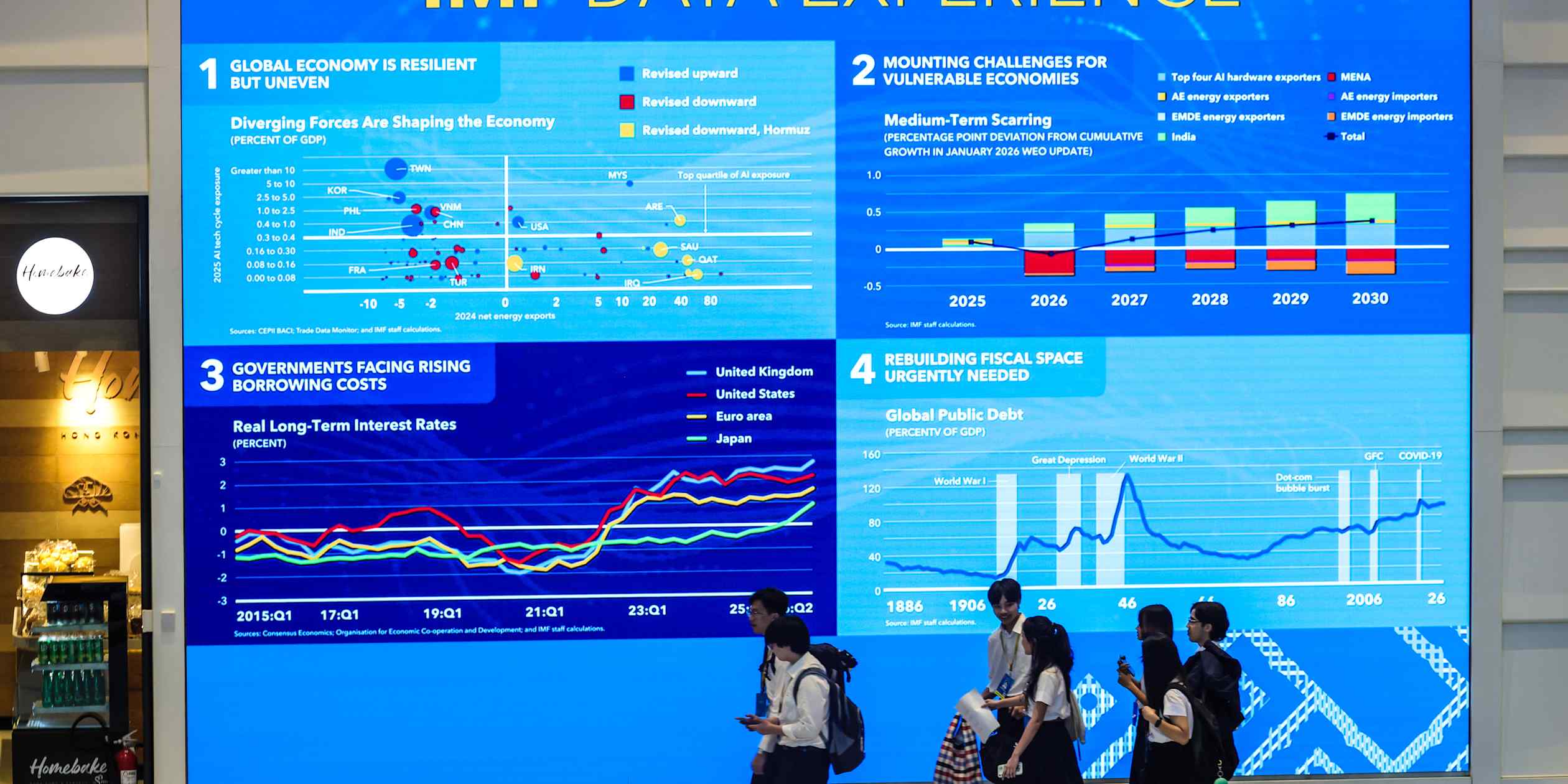
曼谷 — 面对能源供应冲击和生活成本危机恶化,亚洲凭借稳健的经济增长展现出韧性,但这种韧性正日益显现出不均衡,因为一些国家错过了人工智能热潮和其他有利因素。
BANGKOK -- Asia has demonstrated resilience with solid economic growth in the face of an energy supply shock and a worsening cost-of-living crisis, but that strength is proving increasingly uneven as some countries miss out on the AI boom and other tailwinds.
这是国际货币基金组织和世界银行年会的主要收获之一,该年会在曼谷举办一周后于周日结束。
That is among key takeaways from the International Monetary Fund and World Bank annual meetings that wrapped up Sunday after a week in Bangkok.
在此次会议期间,国际货币基金组织在其旗舰报告《世界经济展望》中预测,全球经济今年将增长3.1%,2027年将增长3.4%,后者较其春季预测上调了0.2个百分点。对于亚洲和太平洋地区,该组织预测今年增长4.8%,2027年增长4.4%,分别上调了0.4和0.1个百分点。
During the gathering, the IMF projected global growth of 3.1% this year and 3.4% in 2027 in its flagship World Economic Outlook with the latter revised up 0.2 percentage point from its spring forecast. For Asia and the Pacific, it projected growth of 4.8% this year and 4.4% in 2027, up 0.4 and 0.1 percentage point, respectively.
人工智能投资激增,加上财政缓冲使各国政府能够在能源价格高企的情况下支持家庭,帮助各经济体抵御了冲击。但这些总体数据掩盖了地区内部的显著差异。
surge in artificial intelligence investment along with fiscal buffers that allowed governments to support households amid elevated energy prices, helped economies weather the shocks. But the headline figures mask significant differences across the region.
“该地区确实呈现出高度分化的格局,这正是韧性的根基所在,”国际货币基金组织副总干事纳达·舒埃里在会议期间对《日经亚洲》表示。
"It is indeed a very differentiated picture across the region that is underpinning this resilience," Nada Choueiri, deputy director at the International Monetary Fund, told Nikkei Asia on the sidelines of the gathering.
这种分化在曼谷会议中主导讨论的三大主题中清晰可见:人工智能、气候和私人资本的获取。
The divide was evident across three major themes that dominated discussions in Bangkok: AI, climate and access to private capital.
人工智能:供应链之外的国家“错失热潮” 半导体及相关设备的需求因数据中心建设激增和其他人工智能基础设施而上升,推动了多个亚洲经济体的出口增长。韩国、台湾、印度、日本、马来西亚和新加坡是主要受益国。该热潮也为这些经济体中的一些资本市场提供了提振。
AI: Countries outside supply chain 'left out of boom' Demand for semiconductors and related equipment, fueled by a surge in data center construction and other AI infrastructure, has lifted exports across several Asian economies. South Korea, Taiwan, India, Japan, Malaysia and Singapore are among the main beneficiaries. The boom has also provided a lift to capital markets in some of these economies.
舒埃里表示,未来不在人工智能供应链中的经济体可能无法从人工智能热潮中获益。
Choueiri says that economies outside of the AI supply chain will likely not benefit from the AI boom in the future.
另一方面,经济体“如果没有真正融入支持人工智能的技术出口和生产中,就不会从人工智能热潮中受益,并且很可能继续不受益”,Choueiri 表示。
On the other hand, economies "not really integrated in the exports and production of technology that is supporting AI are not benefiting from the AI boom and they will likely continue not benefiting from it," said Choueiri.
面对一系列经济压力,国际货币基金组织下调了菲律宾、缅甸、柬埔寨、孟加拉国、斐济和巴布亚新几内亚2026年的增长预测。
Against a range of economic pressures, the IMF revised down 2026 growth forecasts for the Philippines, Myanmar, Cambodia, Bangladesh, Fiji and Papua New Guinea.
总裁克里斯塔利娜·格奥尔基耶娃也提出了类似观点,称在经济数据背后,“各国之间存在广泛分歧”。她表示,与人工智能供应链紧密融合的经济体以及未受战争影响的能源出口国“表现较好”。受冲击最大的是“脆弱和受冲击影响国家中的低收入国家”,特别是能源进口国以及那些“被排除在技术热潮之外”的国家。
Managing Director Kristalina Georgieva made a similar point, saying that behind the economic figures, "there are wide divergences among countries." Along with economies closely integrated in the AI supply chain, energy exporters not affected by wars are "doing better," she said. Those taking the biggest hit are "low-income countries in fragile and conflict-affected states," particularly energy importers and those "left out of the technology boom."
气候:菲律宾央行行长警告称‘哥斯拉厄尔尼诺’ 年度会议由泰国首次在35年后主办,时间恰逢曼谷及周边地区遭遇严重洪水两周后。除了洪水,干旱和日益加剧的水资源压力正在给该地区带来经济压力,扰乱大宗商品和肥料生产以及交通运输。
Climate: Philippine central bank chief warns of 'Godzilla El Nino' The annual meetings, hosted by Thailand for the first time in 35 years, came two weeks after Bangkok and surrounding areas were hit by serious floods Beyond flooding, droughts and growing water stress are creating economic strains across the region, disrupting commodity and fertilizer production as well as transportation.
9月28日,妇女们使用泡沫箱在曼谷被洪水淹没的街道上搬运杂货。国际货币基金组织会议在此次洪水袭击城市及周边地区约两周后举行。
Women use foam boxes to carry groceries along a flooded street in Bangkok on Sept. 28. The IMF meetings were held about two weeks after the flooding hit the city and surrounding areas.
“我们正屏息以待。我们必须为最坏的情况做好准备,”菲律宾央行行长埃利·雷莫洛纳 Jr. 在年会期间的一次会议上表示,因为该国正在为他所说的“明年早些时候将出现的‘哥斯拉厄尔尼诺’”做准备。
"We are holding our breath. We have to be prepared for the worst," said Philippine central bank Gov. Eli Remolona Jr. during a session at the annual meetings, as the country braces for what he called a " Godzilla El Nino " early next year.
国际货币基金组织警告称,过去的厄尔尼诺事件曾推高食品和大宗商品价格,同时拖累经济活动,特别是在低收入经济体中。
The IMF has warned that past El Nino episodes have pushed up food and commodity prices while weighing on economic activity, particularly in low-income economies.
国际货币基金组织(IMF)副主管鲁帕·杜塔古普塔(Rupa Duttagupta)指出,除了基础设施遭到严重破坏外,更严重的后果是人员伤亡。她表示,不同国家可能会面临特定的影响,例如“农业生产力下降”或“能源供应中断”,并补充说:“从政策优先级的角度来看,这意味着需要重建财政缓冲机制,以便投资于具有气候适应能力的基础设施”,同时还需要降低能源消耗强度并“增加可再生能源的使用比例”。
IMF Deputy Director Rupa Duttagupta highlighted that along with the "immediate destruction of infrastructure there is the much worse consequence of human loss." There could be country-specific effects including the "loss of agricultural productivity or disruption of energy supply," she said, adding that "in terms of policy priorities, this would mean rebuilding fiscal buffers so that you can invest in climate-resilient infrastructure," as well as reducing energy intensity and "increasing the share of renewable energy."
非营利组织“全球能源联盟为人类与地球服务”(Global Energy Alliance for People and Planet)的首席执行官吴忠宇(Woochong Um)指出,极端天气事件的频发正在迫使各国政府更加重视应对气候变化的问题,包括采取减排措施和提升自身的适应能力。
Woochong Um, CEO of the nonprofit Global Energy Alliance for People and Planet, said increasingly frequent extreme weather events are forcing governments to take climate risks more seriously, both in terms of mitigation and adaptation. "Once-in-100-year events are happening every year, and it's something that we thought could happen in the next generation but is happening now," he said, stressing that "adaptation is urgent."
吴忠宇强调:“原本被认为只会每百年发生一次的极端天气事件,现在每年都在发生;这种变化本应在下一代才会出现,但实际上已经发生了。”他强调:“因此,采取适应措施迫在眉睫。”他还表示,项目开发商和规划者正在越来越多地将与气候相关的灾害风险纳入他们的规划中,以便在真正的危机发生之前就提前做好应对准备。
Um said project developers and planners are increasingly incorporating climate-related disaster risks into their planning so they can "proactively address it before the real crisis hits." Philippine central bank Gov. Eli Remolona Jr. warned about the dangers of a "Godzilla El Nino" during a panel at the IMF and World Bank meetings in Bangkok on Oct. 14.
在10月14日于曼谷举行的国际货币基金组织与世界银行联合会议上,菲律宾中央银行行长埃利·雷莫洛纳(Eli Remolona Jr.)警告称,“超级厄尔尼诺现象”(即“哥斯拉级厄尔尼诺”)可能带来严重后果。
Private capital: World Bank says significant funding gaps remain The uneven ability to tap private capital was another challenge highlighted during the meetings, particularly as governments contend with limited fiscal space and large infrastructure needs. "The competition for long-term capital has become bigger," Atsi Sheth, chief credit officer at Moody's Ratings, said in an interview with Nikkei Asia.
关于私人资本的问题,世界银行指出资金缺口依然存在。会议中还强调了各国在吸引私人资本方面存在的能力差异,尤其是在政府财政空间有限且基础设施需求巨大的情况下。穆迪评级公司(Moody's Ratings)的首席信贷官阿茨·谢特(Atsi Sheth)在接受《日经亚洲》(Nikkei Asia)采访时指出:“对长期资金的竞争日益激烈。各国政府都希望增加借贷;人工智能相关领域的资本支出也需要更多资金;提升气候适应能力同样需要资金支持;此外,促进经济增长的基础设施项目也需要资金投入。”
"You have now governments wanting to borrow more ... You have the AI sort of capex needing to borrow more. You have climate, resilience building needing the capital, and then you have infrastructure for growth," she pointed out. "It's actually going to be harder and harder, I think, to mobilize private capital for that fourth category," Sheth said. Roughly $329 billion in private capital has been mobilized by the World Bank Group over the past five years, according to Ufuk Akcigit, the bank's deputy chief economist and director of private markets.
“我认为,要为第四类项目筹集私人资本将会变得越来越困难,”Sheth说道。
World Bank data also shows wide differences in private capital expected to be mobilized alongside its commitments across Asian economies.
根据世界银行副首席经济学家兼私人市场部门负责人Ufuk Akcigit的数据,在过去五年中,世界银行集团共筹集了约3290亿美元的私人资本。
The figure for India totals nearly $36 billion, compared with substantially smaller amounts for Sri Lanka, Nepal, Cambodia, the Philippines and Pakistan.
世界银行的数据还显示,各国在预期能够筹集到的私人资本数额方面存在显著差异:印度的私人资本筹集额接近360亿美元,而斯里兰卡、尼泊尔、柬埔寨、菲律宾和巴基斯坦的筹集额则要少得多。
World Bank Managing Director and Chief Knowledge Officer Paschal Donohoe said significant funding gaps remain, particularly for small and medium-sized businesses and "very large infrastructure projects actually taking place."
世界银行行长兼首席知识官Paschal Donohoe表示,尤其是在中小企业以及那些规模庞大的基础设施项目中,资金缺口仍然很大。亚洲开发银行战略、政策与合作伙伴关系部门的负责人Xinning Jia在10月13日的国际货币基金组织(IMF)和世界银行年会上发表了讲话。
Asian Development Bank director general of the strategy, policy, and partnership department Xinning Jia, center, speaks during a session of the IMF and World Bank annual meetings on Oct. 13. Xinning Jia, director general of strategy, policy and partnerships at the Asian Development Bank, told Nikkei Asia that investor interest exists, but countries differ in their ability to turn that interest into actual investment.
Xinning Jia指出,投资者确实表现出兴趣,但各国将这种兴趣转化为实际投资的能力各不相同。她强调,对于亚洲开发银行等多边开发银行来说,最重要的是“将这种潜力转化为现实的机会”,这需要相应的政策、法律法规以及完善的制度体系。“私营部门不会愿意坐等观望。”她补充说,对于那些经济脆弱的小岛国家而言,多边开发银行可能需要通过优惠贷款等方式来帮助这些国家建立市场。
The most important thing for multilateral development banks like ADB is "to really bridge that possibility into opportunity," she said, pointing to the need for appropriate policies, legislation and institutional capacity. "The private sector will not have patience to wait and see." For fragile economies and small island states, multilateral development banks may initially need to help establish markets, including through concessional financing, she added.